

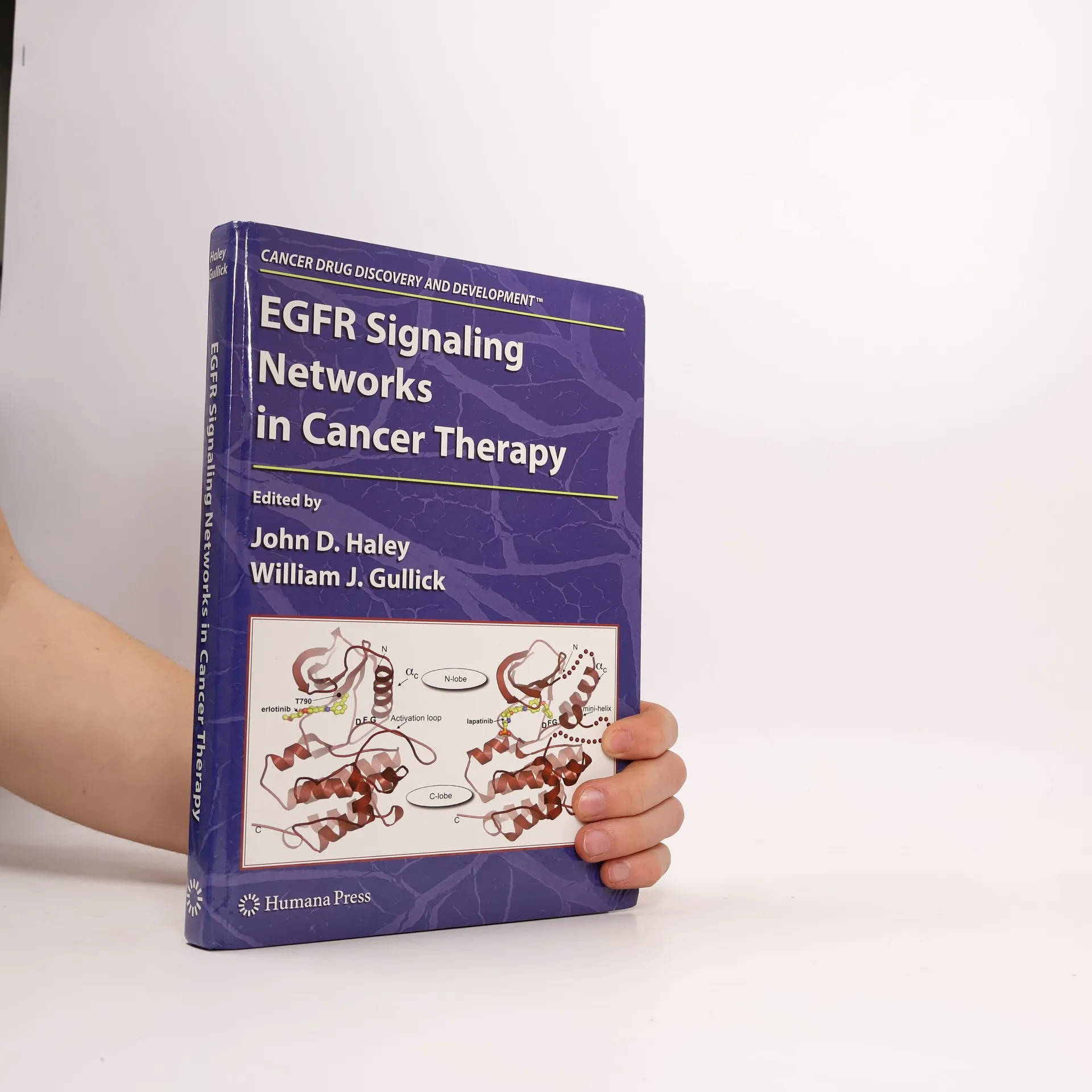
Cancer Drug Discovery and Development: EGFR Signaling Networks in Cancer Therapy
Autor*innen
Mehr zum Buch
The epidermal growth factor (EGF) receptor and its downstream signaling networks are crucial in tumor development and maintenance, driving the search for targeted anti-EGF receptor therapies. Extensive research has detailed the EGF receptor's structure, ligand binding domains, intrinsic tyrosine kinase function, and interactions with signaling adaptor proteins like SH2, PTB, and SH3, which are essential for signal transduction. The EGF receptor serves as a central hub for various signaling pathways and interacts with three other family receptors, forming dimers and oligomers in response to at least eleven ligands, some of which have overlapping or distinct functions. This interaction activates multiple second messenger proteins and facilitates cross-talk between systems, adding complexity to the signaling landscape. However, the cross-regulation of the EGF receptor with other anti-apoptotic, mitogenic, and metabolic signaling systems remains less understood. New findings continue to emerge from studying these interactions, although a significant challenge has been the tendency to define signaling pathways without considering their tissue-specific or cell-interaction contexts.
Buchkauf
Cancer Drug Discovery and Development: EGFR Signaling Networks in Cancer Therapy, William John Gullick, John D. Haley
- Sprache

- Erscheinungsdatum
- 2008
- Einband
- (Hardcover)
Keiner hat bisher bewertet.
- Titel
- Cancer Drug Discovery and Development: EGFR Signaling Networks in Cancer Therapy
- Sprache
- Englisch
- Autor*innen
- William John Gullick, John D. Haley
- Verlag
- Springer
- Erscheinungsdatum
- 2008
- Einband
- Hardcover
- Seitenzahl
- 393
- ISBN10
- 1588299481
- ISBN13
- 9781588299482
- Reihe
- Kategorien
- Schlagwörter
- Medizin & Gesundheit, Wissenschaft, Medizin, Gesammelte Werke, Krebs, Tumoren, Pharmakologie, Onkologie, Chemotherapie
- Beschreibung
- The epidermal growth factor (EGF) receptor and its downstream signaling networks are crucial in tumor development and maintenance, driving the search for targeted anti-EGF receptor therapies. Extensive research has detailed the EGF receptor's structure, ligand binding domains, intrinsic tyrosine kinase function, and interactions with signaling adaptor proteins like SH2, PTB, and SH3, which are essential for signal transduction. The EGF receptor serves as a central hub for various signaling pathways and interacts with three other family receptors, forming dimers and oligomers in response to at least eleven ligands, some of which have overlapping or distinct functions. This interaction activates multiple second messenger proteins and facilitates cross-talk between systems, adding complexity to the signaling landscape. However, the cross-regulation of the EGF receptor with other anti-apoptotic, mitogenic, and metabolic signaling systems remains less understood. New findings continue to emerge from studying these interactions, although a significant challenge has been the tendency to define signaling pathways without considering their tissue-specific or cell-interaction contexts.