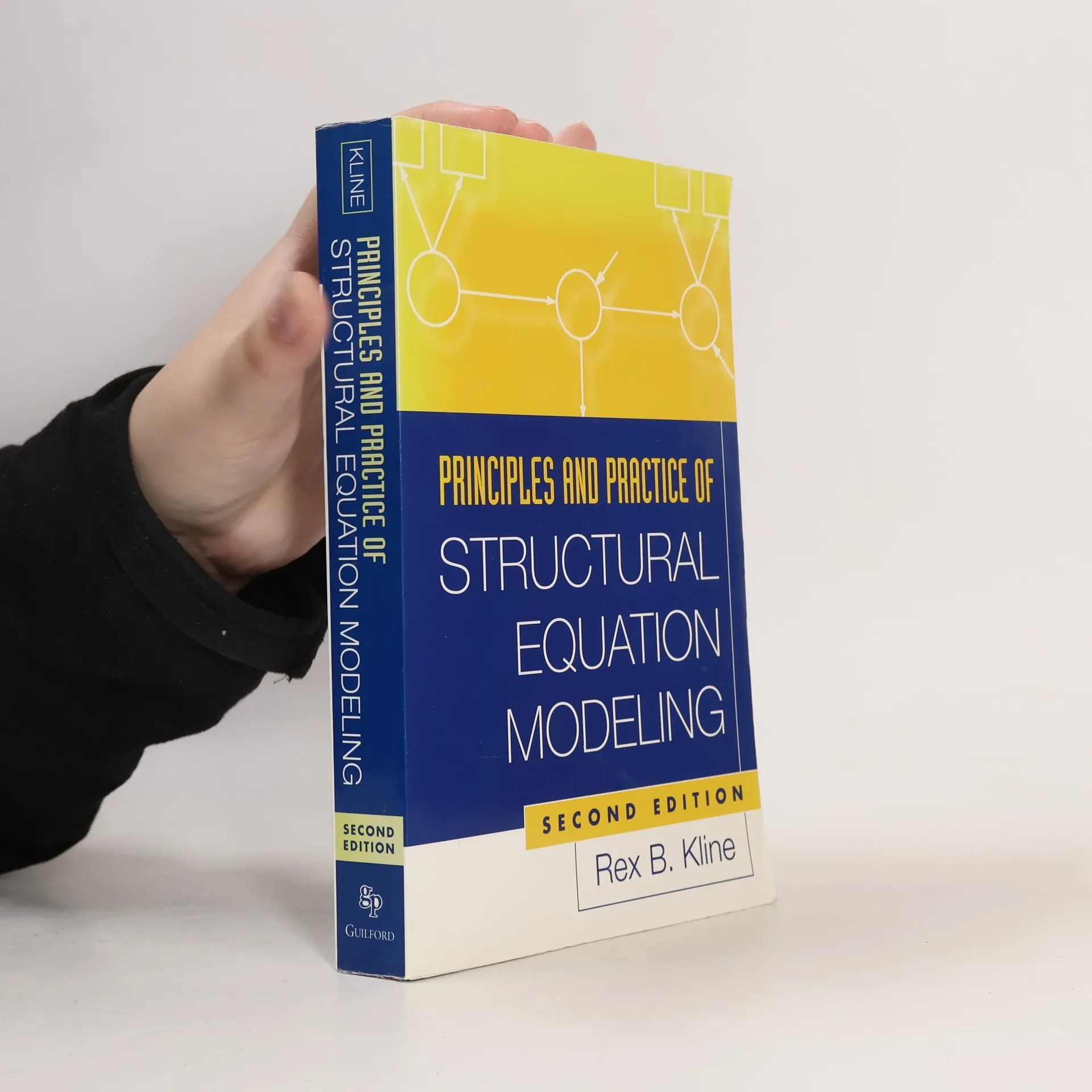
This comprehensive fifth edition delves into all three approaches to structural equation modeling (SEM), including covariance-based, nonparametric, and composite SEM. It emphasizes the use of accessible software tools like R lavaan, guiding readers through the phases of SEM with best practices and common pitfalls. The text features learning exercises and a new self-test focusing on significance testing, regression, and psychometrics. Additionally, a companion website offers valuable resources such as primers, data, syntax, and output related to the book's examples.
This widely used and accessible structural equation modeling (SEM) text emphasizes concepts and rationale over mathematical details. The revised fourth edition includes real data examples from various disciplines and incorporates recent developments such as Pearl's graphing theory, structural causal models (SCM), and measurement invariance. Readers will gain a thorough understanding of all SEM phases, from data collection to result interpretation and reporting. Learning is supported by exercises with answers, rules to remember, and topic boxes. A companion website offers data, syntax, and output for examples, now featuring files for Amos, EQS, LISREL, Mplus, Stata, and R (lavaan).
New features in this edition include coverage of important topics like causal inference frameworks, conditional process modeling, and item response theory. It also includes chapters on best practices for all SEM stages, measurement invariance in confirmatory factor analysis, and bootstrapping significance testing. The text has expanded psychometrics coverage and reorganized content to separately address observed and latent variable models. Pedagogical features include exercises with answers, real examples of data issues, topic boxes on specialized issues, and a website promoting a learn-by-doing approach with syntax and data files for six SEM tools.
This popular text provides an accessible guide to the application, interpretation, and pitfalls of structural equation modeling (SEM). Reviewed are fundamental statistical concepts--such as correlation, regressions, data preparation and screening, path analysis, and confirmatory factor analysis--as well as more advanced methods, including the evaluation of nonlinear effects, measurement models and structural regression models, latent growth models, and multilevel SEM. The companion Web page offers data and program syntax files for many of the research examples, electronic overheads that can be downloaded and printed by instructors or students, and links to SEM-related resources.