Bookbot

Mark E. Russinovich

    Mark Russinovich ist ein Technical Fellow in Microsofts Cloud-Betriebssystemgruppe. Er ist ein weithin anerkannter Experte für die internen Abläufe des Windows-Betriebssystems sowie für dessen Architektur und Design. Seine Arbeit umfasst die Entwicklung von Diagnosewerkzeugen für die Systemadministration und tiefgehende technische Analysen der Betriebssysteminterna.

    Trojan Horse
    Microsoft windows internals, fourth edition : microsoft windows server 2003, windows XP, and windows 2000
    Windows internals. Part 1
    Windows internals
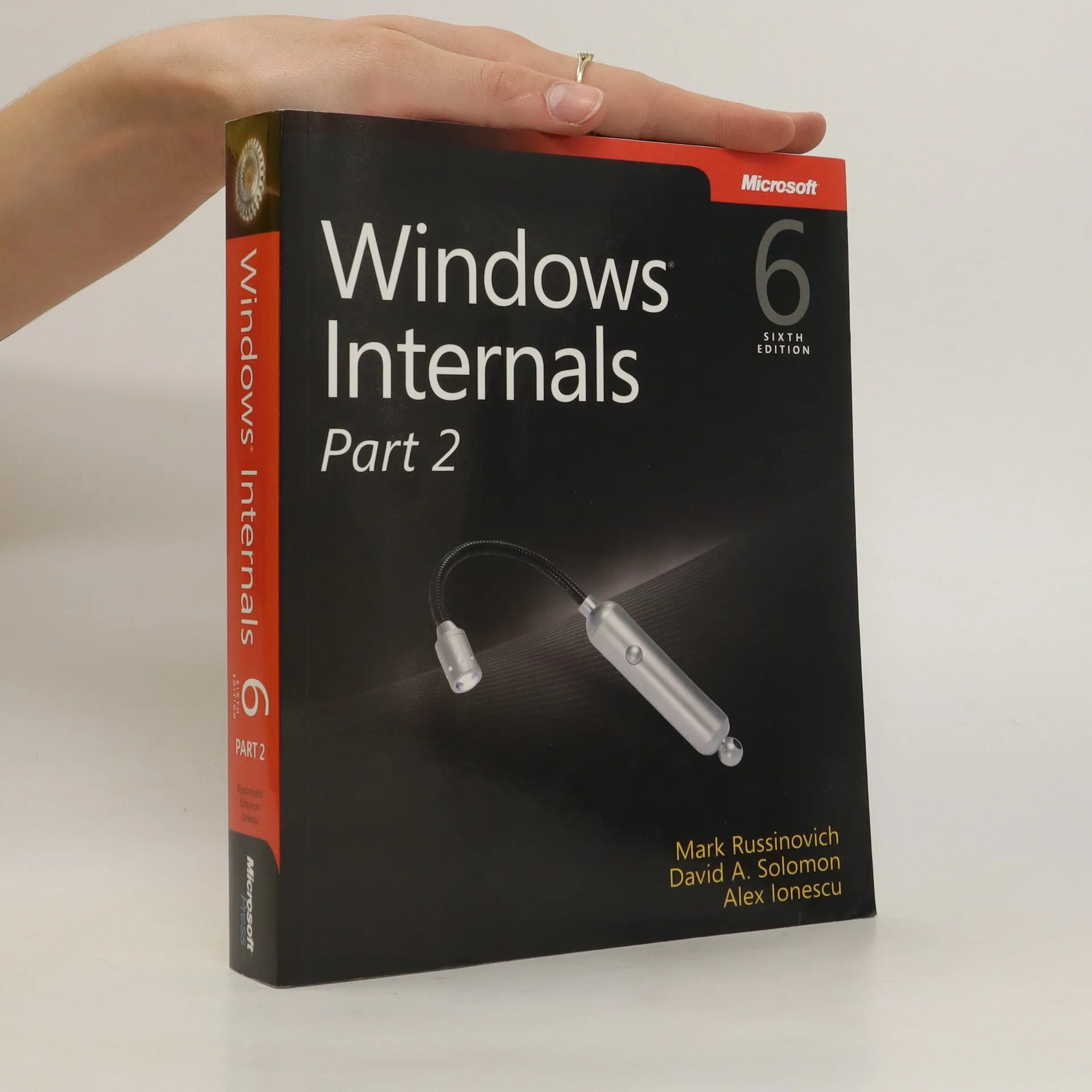
    Windows Internals, Sixth Edition : Part 2
    Inside Microsoft Windows 2000 - 3. Auflage
    • This newly updated, official guide to the Microsoft "RM" Windows 2000 core architecture and internals provides the key to help readers unlock the full power of Microsoft's premier operating system. Written in full partnership with the Microsoft Windows 2000 product development team, this book takes developers, technical managers, and IS professionals deep into the core components of Windows 2000. Along the way, it provides abundant information and perspective that readers can quickly apply for better design, debugging, performance, and troubleshooting. It's packed with up-to-the-minute information -- and unrivaled programming insights -- about topics such as Plug and Play, power management, the Windows Driver Model, security, 64-bit extended addressing support, job objects, new priority classes, NTFS extensions, kernel streaming and kernel code, and registry internals. In short, this is the must-have text for anyone who wants to get the most out of Microsoft Windows 2000.
      Inside Microsoft Windows 2000 - 3. Auflage
    • Windows internals

      • 1232 Seiten
      • 44 Lesestunden

      See how the core components of the Windows operating system work behind the scenes--guided by a team of internationally renowned internals experts. Fully updated for Windows Server(R) 2008 and Windows Vista(R), this classic guide delivers key architectural insights on system design, debugging, performance, and support--along with hands-on experiments to experience Windows internal behavior firsthand. Delve inside Windows architecture and internals: Understand how the core system and management mechanisms work--from the object manager to services to the registry Explore internal system data structures using tools like the kernel debugger Grasp the scheduler's priority and CPU placement algorithms Go inside the Windows security model to see how it authorizes access to data Understand how Windows manages physical and virtual memory Tour the Windows networking stack from top to bottom--including APIs, protocol drivers, and network adapter drivers Troubleshoot file-system access problems and system boot problems Learn how to analyze crashes

      Windows internals
      4,5
    • Windows internals. Part 1

      • 726 Seiten
      • 26 Lesestunden

      A guide to the architecture and internal structure of Microsoft Windows and Microsoft Windows server.

      Windows internals. Part 1
      4,5
    • Trojan Horse

      • 336 Seiten
      • 12 Lesestunden

      The West is under its greatest threat yet in Mark Russinovich's Trojan Horse. A revolutionary, invisible computer virus that alters data without leaving a trace—more sophisticated than any seen before—has been identified within the computers of the United Nations, roiling international politics. Cybersecurity analysts Jeff Aiken and Daryl Haugen are summoned to root it out and discover its source. As the virus penetrates Western intelligence, and the terrifying truth about its creator is revealed, Jeff and Daryl find themselves in a desperate race to reverse it as the fate of both East and West hangs in the balance.

      Trojan Horse
      4,2
    • The Sysinternals utilities are indispensable and very popular tools for diagnosing, troubleshooting, and researching the Windows platform. Troubleshooting with the Windows Sysinternals Tools, Second Edition, is the most accurate and complete reference for these utilities and includes an expanded Case of the Unexplained section that illustrates their use, detailed coverage of new tools and updated features in existing tools, and a Procmon and ProcDump, Better Together feature demonstrating new capabilities that the tools now enable in each other.

      Troubleshooting with the Windows Sysinternals Tools
      4,1
    • An airliner’s controls abruptly fail mid-flight over the Atlantic. An oil tanker runs aground in Japan when its navigational system suddenly stops dead. Hospitals everywhere have to abandon their computer databases when patients die after being administered incorrect dosages of their medicine. In the Midwest, a nuclear power plant nearly becomes the next Chernobyl when its cooling systems malfunction. At first, these random computer failures seem like unrelated events. But Jeff Aiken, a former government analyst who quit in disgust after witnessing the gross errors that led up to 9/11, thinks otherwise. Jeff fears a more serious attack targeting the United States computer infrastructure is already under way. And as other menacing computer malfunctions pop up around the world, some with deadly results, he realizes that there isn’t much time if he hopes to prevent an international catastrophe. Written by a global authority on cyber security, Zero Day presents a chilling “what if” scenario that, in a world completely reliant on technology, is more than possible today---it’s a cataclysmic disaster just waiting to happen.

      Zero Day
      3,5
    • Practical Microservices with Dapr and .NET

      A developer's guide to building cloud-native applications using the event-driven runtime, 2nd Edition

      • 312 Seiten
      • 11 Lesestunden

      Use an innovative, portable event-driven distributed application runtime to simplify building resilient and scalable microservices for cloud and edge applications. This second edition will help you grasp microservice architectures and manage application complexities with Dapr quickly. You'll discover how Dapr simplifies development across multiple languages and platforms. Through a C# sample, you'll learn how Dapr's runtime, building blocks, and software development kits (SDKs) facilitate the creation of resilient and portable microservices. Dapr provides an event-driven runtime supporting essential features like service invocation, state management, and publish/subscribe messaging. This practical guide covers these features and more, focusing on deploying a Dapr sample application to an Azure Kubernetes Service cluster and the Azure Container Apps serverless platform. You'll learn to expose the Dapr application using NGINX, YARP, and Azure API Management. By the end, you'll be equipped to write microservices easily, implementing industry best practices to address distributed systems challenges. This resource is ideal for developers eager to explore and implement microservices architectures in Dapr applications using .NET examples, whether you're new to microservices or seeking hands-on experience with Dapr. Familiarity with .NET will enhance your understanding of the C# samples and code snippets.

      Practical Microservices with Dapr and .NET
    • Practical Microservices with Dapr and .NET

      A developer's guide to building cloud-native applications using the Dapr event-driven runtime

      • 280 Seiten
      • 10 Lesestunden

      Utilize a new, enticing event-driven runtime to simplify the creation of resilient and scalable microservices for cloud and edge applications. Key features include building stateless and stateful microservices, addressing common distributed system challenges like low latency and scaling, and employing real-time monitoring tools for reliability. In recent years, the shift from monolithic applications to self-contained microservices has accelerated. Dapr, an open-source project by Microsoft, provides best practices for developing modern applications across various platforms, including public cloud, on-premises, and edge devices. This guide will help you master microservice architectures and manage application complexities with Dapr efficiently. Dapr's event-driven runtime supports essential features such as service invocation, state management, and publish/subscribe messaging, simplifying the creation of portable microservices. You'll delve into advanced features while learning to write microservices using your preferred language or framework, applying industry best practices to tackle distributed system challenges. Key learning outcomes include creating services with Dapr, understanding microservice architecture best practices, leveraging the actor model for orchestration, deploying applications on Azure Kubernetes Service, and monitoring with tools like Zipkin and Prometheus. This resource is ideal for developers eager to

      Practical Microservices with Dapr and .NET
    • Jeff Aiken: Rogue Code

      • 400 Seiten
      • 14 Lesestunden

      Michael Lewis' work exposed the ruthless nature of high-frequency trading, but Mark Russinovich takes it further, illustrating how this dominance in finance leaves the stock market vulnerable to hackers. Cybersecurity expert Jeff Aiken understands that no system is entirely secure. When he investigates a potential breach at the New York Stock Exchange, he uncovers an alarming reality: the system has been compromised, and insiders are aware but have allowed hackers to steal millions without intervention. As Jeff reveals the crime, the NYSE turns against him, accusing him of grand larceny. He must expose the criminals not only to clear his name but to prevent a multibillion-dollar heist that threatens the U.S. economy. Ignoring his warnings, the NYSE plans to proceed with a major IPO using a new, untested system vulnerable to both hackers and aggressive high-frequency traders. Determined to uncover the truth, Jeff follows the trail to the dangerous streets of Rio de Janeiro, confronting one of the world's most ruthless cartels. Blending real-world technology with fast-paced action, Russinovich delivers a gripping thriller about a cyber threat that feels alarmingly plausible, alongside the Wall Street traders who may facilitate such a disaster.

      Jeff Aiken: Rogue Code