

Bookbot

H. Eugene Stanley

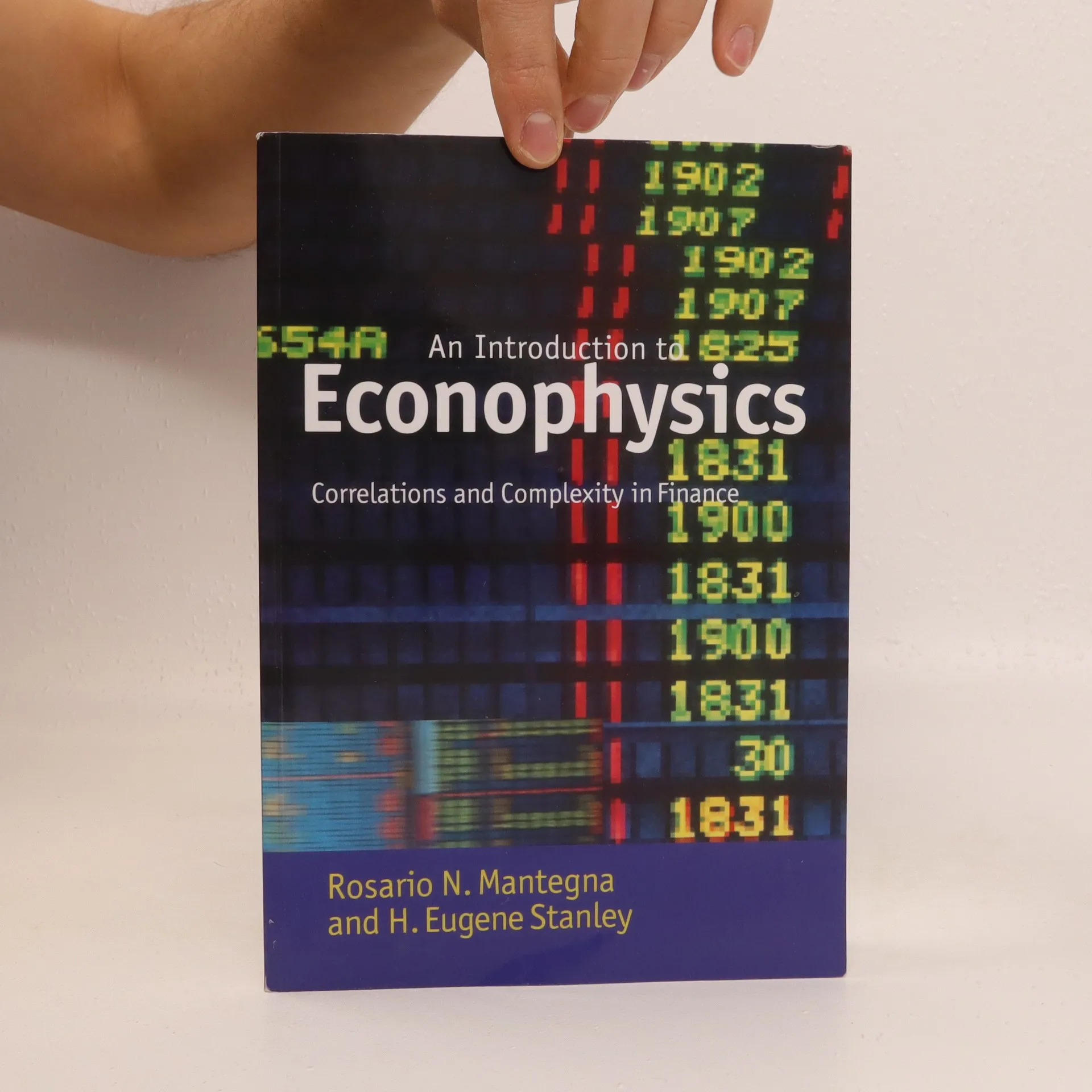
    An introduction to econophysics : correlations and complexity in finance
    Fractal Concepts in Surface Growth
    • Fractal Concepts in Surface Growth

      • 388 Seiten
      • 14 Lesestunden

      Fractals and surfaces are two of the most widely-studied areas of modern physics. In fact, most surfaces in nature are fractals. In this book, Drs. Barabási and Stanley explain how fractals can be successfully used to describe and predict the morphology of surface growth. The authors begin by presenting basic growth models and the principles used to develop them. They next demonstrate how models can be used to answer specific questions about surface roughness. In the second half of the book, they discuss in detail two classes of fluid flow in porous media and molecular beam epitaxy (MBE). In each case, the authors review the model and analytical approach, and present experimental results. This book is the first attempt to unite the subjects of fractals and surfaces, and it will appeal to advanced undergraduate and graduate students in condensed matter physics and statistical mechanics. Because of the technological importance of MBE, it will also be of interest to scientists, particularly materials scientists, working in industry and research. Interested readers may view a sample chapter by contacting our web site at

      Fractal Concepts in Surface Growth
      4,3
    • Statistical physics concepts such as stochastic dynamics, short- and long-range correlations, self-similarity and scaling, permit an understanding of the global behavior of economic systems without first having to work out a detailed microscopic description of the system. This pioneering text explores the use of these concepts in the description of financial systems, the dynamic new specialty of econophysics. The authors illustrate the scaling concepts used in probability theory, critical phenomena, and fully-developed turbulent fluids and apply them to financial time series. They also present a new stochastic model that displays several of the statistical properties observed in empirical data. Physicists will find the application of statistical physics concepts to economic systems fascinating. Economists and other financial professionals will benefit from the book's empirical analysis methods and well-formulated theoretical tools that will allow them to describe systems composed of a huge number of interacting subsystems.

      An introduction to econophysics : correlations and complexity in finance
      3,6