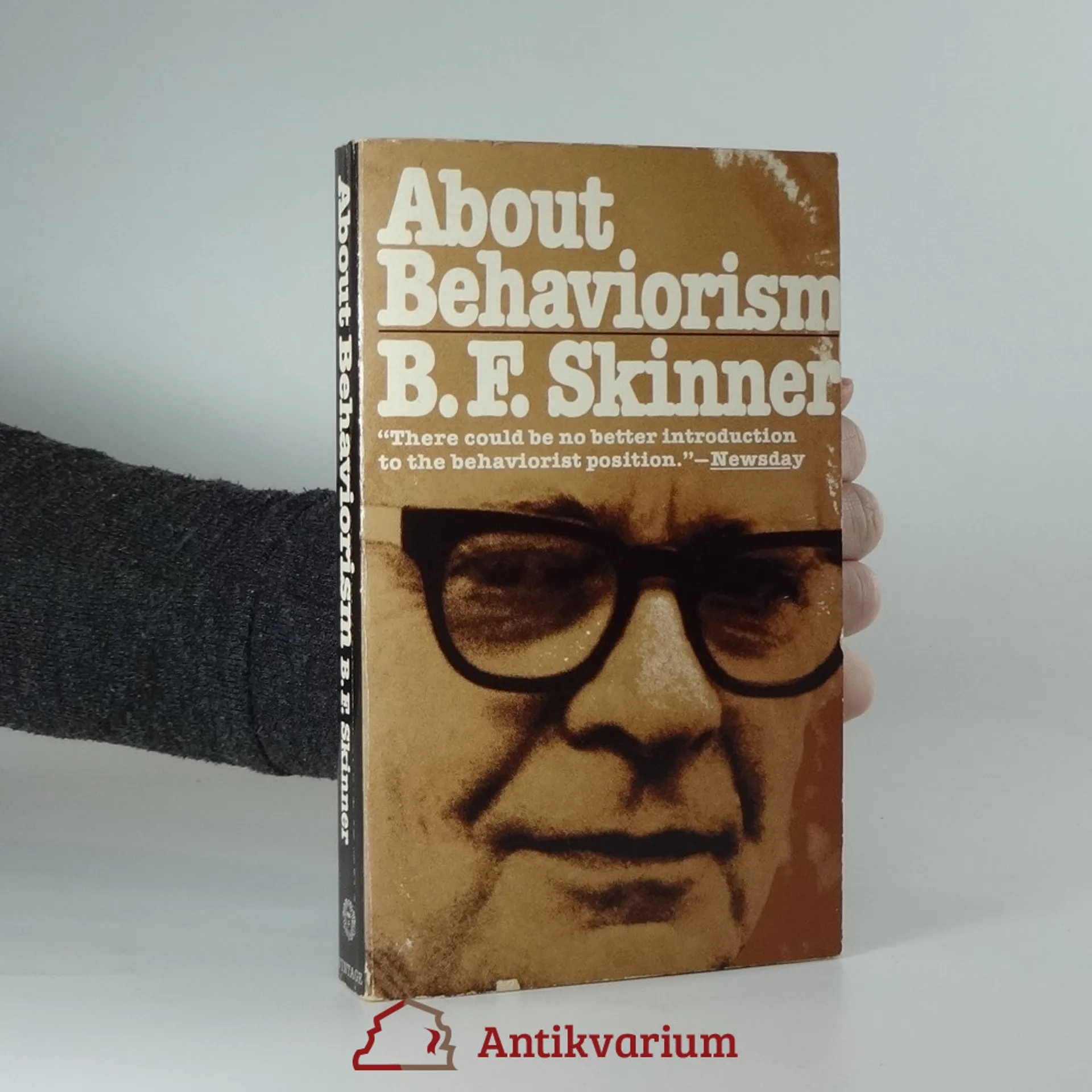
B. F. Skinner Bücher
B. F. Skinner war eine Schlüsselfigur der Psychologie des 20. Jahrhunderts, die unser Verständnis menschlichen Verhaltens maßgeblich prägte. Er ist bekannt für sein Konzept des radikalen Behaviorismus, das Verhalten als Ergebnis von Umweltinteraktion und Verstärkung untersucht. Skinners Einfluss reicht weit über die akademische Welt hinaus, seine Ideen beeinflussen Bildung, Therapie und sogar die Gestaltung von Gesellschaftssystemen. Sein Ansatz betont beobachtbares Verhalten und dessen Kontrolle und bietet Lesern eine einzigartige Perspektive auf die Mechanismen, die unser Handeln bestimmen.







Jenseits von Freiheit und Würde
- 219 Seiten
- 8 Lesestunden
Futurum Zwei
Das klassische Buch des führenden amerikanischen Verhaltenspsychologen über die Möglichkeiten einer radikalen Veränderung des Menschen durch die Wissenschaft.
- 280 Seiten
- 10 Lesestunden
Verbal behavior
- 492 Seiten
- 18 Lesestunden
2015 Reprint of 1957 Edition. Full facsimile of the original edition. Not reproduced with Optical Recognition Software. The significance of this work was grasped immediately. Osgood wrote that "Verbal Behavior is certainly one of the two or three most significant contributions to this field in our time." (Osgood, 1958, p. 212). Morris wrote that "Skinner is both elegant and admirable (Morris, 1958, p. 213.) Both predicted a promising future for the book and such did turn out to be the case. Over more than half a century after its initial publication in 1957, "Verbal Behavior" has remained in demand and continues to be relevant. The documented efficacy of Skinner's practices, especially with autism, has assured its relevance. His functional analysis of language continues to inform contemporary research in the field of linguistics. Contents: A functional analysis of verbal behavior -- General problems -- The mand -- Verbal behavior under the control of verbal stimuli -- The tact -- Special conditions affecting stimulus control -- The audience -- The verbal operant as a unit of analysis -- Multiple causation -- Supplementary stimulation -- New combinations of fragmentary responses -- The autoclitic -- Grammar and syntax as autoclitic processes -- Composition and its effects -- Self-editing -- Special conditions of self-editing -- Self-strengthening of verbal behavior -- Logical and scientific verbal behavior -- Thinking.
Walden Two
- 352 Seiten
- 13 Lesestunden
A Utopian community organized around behaviorist principles offers provocative alternatives to a society lacking direction.
The psychology classic—a detailed study of scientific theories of human nature and the possible ways in which human behavior can be predicted and controlled—from one of the most influential behaviorists of the twentieth century and the author of Walden Two.“This is an important book, exceptionally well written, and logically consistent with the basic premise of the unitary nature of science. Many students of society and culture would take violent issue with most of the things that Skinner has to say, but even those who disagree most will find this a stimulating book.” —Samuel M. Strong, The American Journal of Sociology“This is a remarkable book—remarkable in that it presents a strong, consistent, and all but exhaustive case for a natural science of human behavior…It ought to be…valuable for those whose preferences lie with, as well as those whose preferences stand against, a behavioristic approach to human activity.” —Harry Prosch, Ethics
Poza wolnością i godnością
- 235 Seiten
- 9 Lesestunden