



Parameter
- 184 Seiten
- 7 Lesestunden
Mehr zum Buch
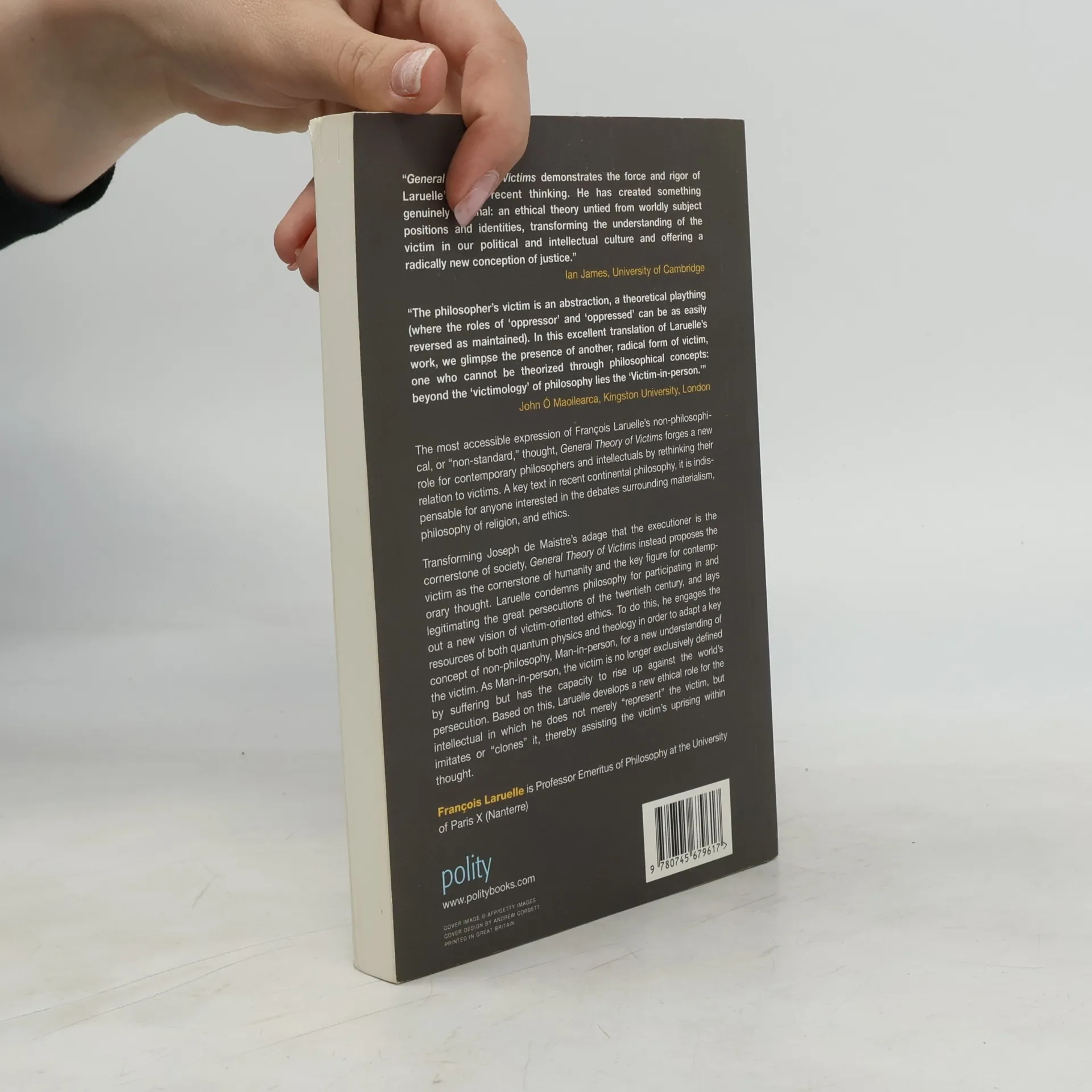
The most accessible expression of FranCois Laruelle's non-philosophical, or 'non-standard', thought, <i>General Theory of Victims</i> forges a new role for contemporary philosophers and intellectuals by rethinking their relation to victims. A key text in recent continental philosophy, it is indispensable for anyone interested in the debates surrounding materialism, philosophy of religion, and ethics. Transforming Joseph de Maistre's adage that the executioner is the cornerstone of society, <i>General Theory of Victims</i> instead proposes the victim as the cornerstone of humanity and the key figure for contemporary thought. Laruelle condemns philosophy for participating in and legitimating the great persecutions of the twentieth century, and lays out a new vision of victim-oriented ethics. To do this, he engages the resources of both quantum physics and theology in order to adapt a key concept of non-philosophy, Man-in-person, for a new understanding of the victim. As Man-in-person, the victim is no longer exclusively defined by suffering, but has the capacity to rise up against the world's persecution. Based on this, Laruelle develops a new ethical role for the intellectual in which he does not merely 'represent' the victim, but imitates or 'clones' it, thereby assisting the victim's uprising within thought.
Buchkauf
General Theory of Victims, François Laruelle
- Sprache

- Erscheinungsdatum
- 2015
- Einband
- (Paperback),
- Buchzustand
- Gebraucht - Gut
- Preis
- € 18,49
Keiner hat bisher bewertet.
- Titel
- General Theory of Victims
- Sprache
- Englisch
- Autor*innen
- François Laruelle
- Verlag
- Polity
- Erscheinungsdatum
- 2015
- Einband
- Paperback
- Seitenzahl
- 184
- ISBN10
- 0745679617
- ISBN13
- 9780745679617
- Reihe
- Kategorien
- Schlagwörter
- Frankreich, Fachliteratur, Gesellschaft, Wissenschaftliche Theorien, Ethik, Kriminalität, Gerechtigkeit, Philosophie der Sprache, Rechtsphilosophie, Opferforschung
- Beschreibung
- The most accessible expression of FranCois Laruelle's non-philosophical, or 'non-standard', thought, <i>General Theory of Victims</i> forges a new role for contemporary philosophers and intellectuals by rethinking their relation to victims. A key text in recent continental philosophy, it is indispensable for anyone interested in the debates surrounding materialism, philosophy of religion, and ethics. Transforming Joseph de Maistre's adage that the executioner is the cornerstone of society, <i>General Theory of Victims</i> instead proposes the victim as the cornerstone of humanity and the key figure for contemporary thought. Laruelle condemns philosophy for participating in and legitimating the great persecutions of the twentieth century, and lays out a new vision of victim-oriented ethics. To do this, he engages the resources of both quantum physics and theology in order to adapt a key concept of non-philosophy, Man-in-person, for a new understanding of the victim. As Man-in-person, the victim is no longer exclusively defined by suffering, but has the capacity to rise up against the world's persecution. Based on this, Laruelle develops a new ethical role for the intellectual in which he does not merely 'represent' the victim, but imitates or 'clones' it, thereby assisting the victim's uprising within thought.