

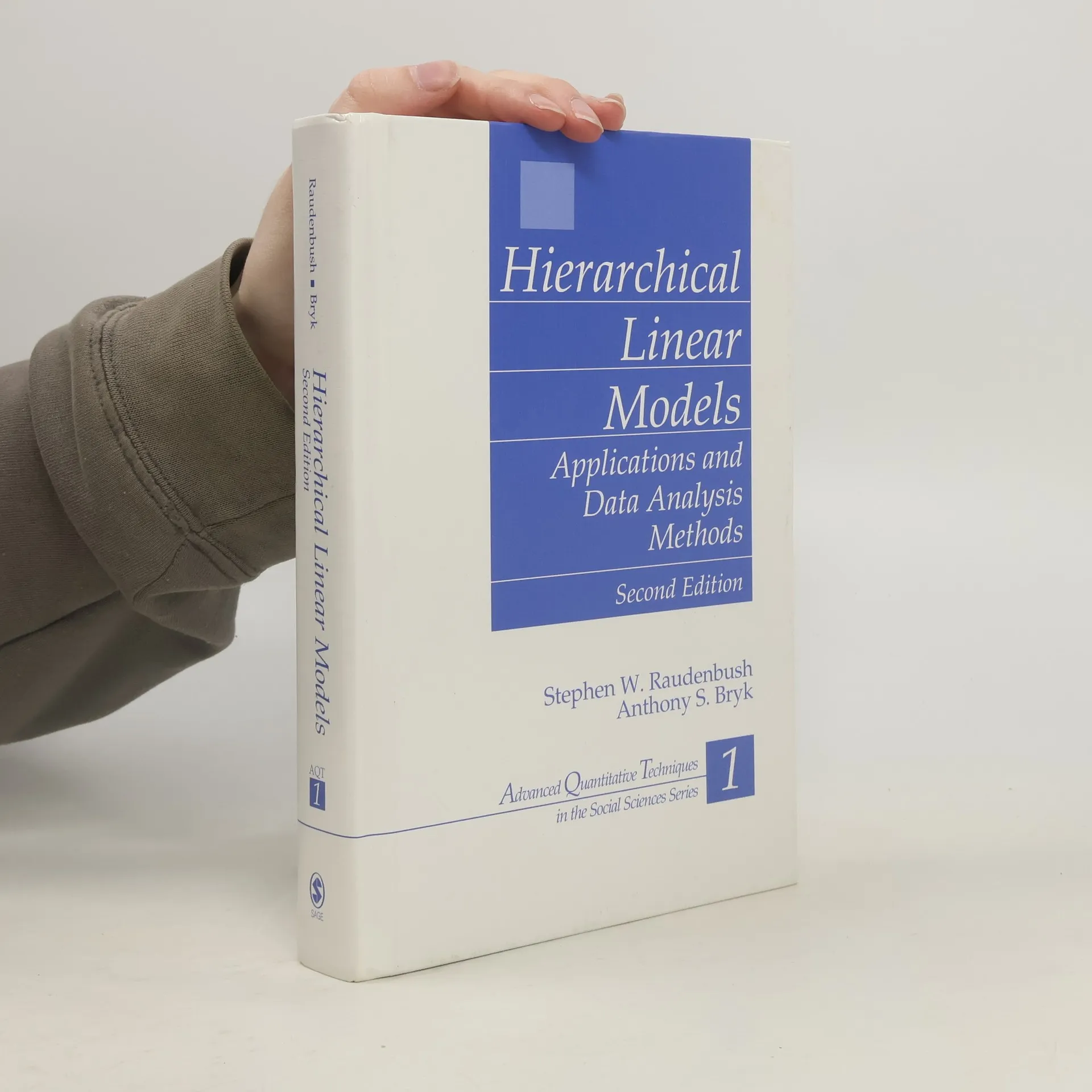
Advanced Quantitative Techniques in the Social Sciences Series - 1: Hierarchical Linear Models
Applications and Data Analysis Methods - Second Edition
- 512 Seiten
- 18 Lesestunden
This first-class resource addresses crucial areas in applied statistics, featuring widely applicable methods and high-quality exposition. The new chapters (10-14) enhance its value for research and instruction by covering models for discrete level-1 outcomes, non-nested level-2 units, incomplete data, and measurement error—essential topics in contemporary social statistics. Written clearly and supported by engaging examples, this expanded edition is particularly beneficial for advanced graduate students and social researchers. Chapter 11 showcases the versatility of mixed models with the EM algorithm, offering new insights and practical solutions to common research challenges. The book is reorganized into four parts, with significant expansions and clarifications. Part I discusses the logic of hierarchical linear modeling, while Part II focuses on basic applications, including an intuitive summary of estimation and inference procedures, multivariate growth models, and research synthesis applications. Part III introduces diverse outcome types, with Chapter 10 exploring hierarchical models for binary outcomes, counted data, ordered categories, and multinomial outcomes. Chapter 11 delves into latent variable models and missing data, while Chapter 13 presents Bayesian inference logic applied to hierarchical data. Part IV concludes with statistical theory and computations, covering univariate models, multivariate linear models, a