
Gratis Versand in ganz Österreich
Bookbot

Andrew May

    Andrew May ist ein ehemaliger Wissenschaftler, dessen Arbeit von einem strengen akademischen Hintergrund geprägt ist. Er nähert sich vielfältigen Themen, von Verteidigungstechnologie und Geschichte bis hin zu Physik und Forteana, mit einer einzigartigen Mischung aus wissenschaftlichem Verständnis und intellektueller Neugier. Seine Schriften erforschen die Schnittstelle zwischen etabliertem Wissen und unkonventionelleren Überzeugungen und bieten den Lesern eine neue Perspektive auf komplexe Themen.

    Andrew May
    The Science of Sci-Fi Music
    Miniature Sorption Coolers
    The Science of Music
    Astrobiology
    The Space Business
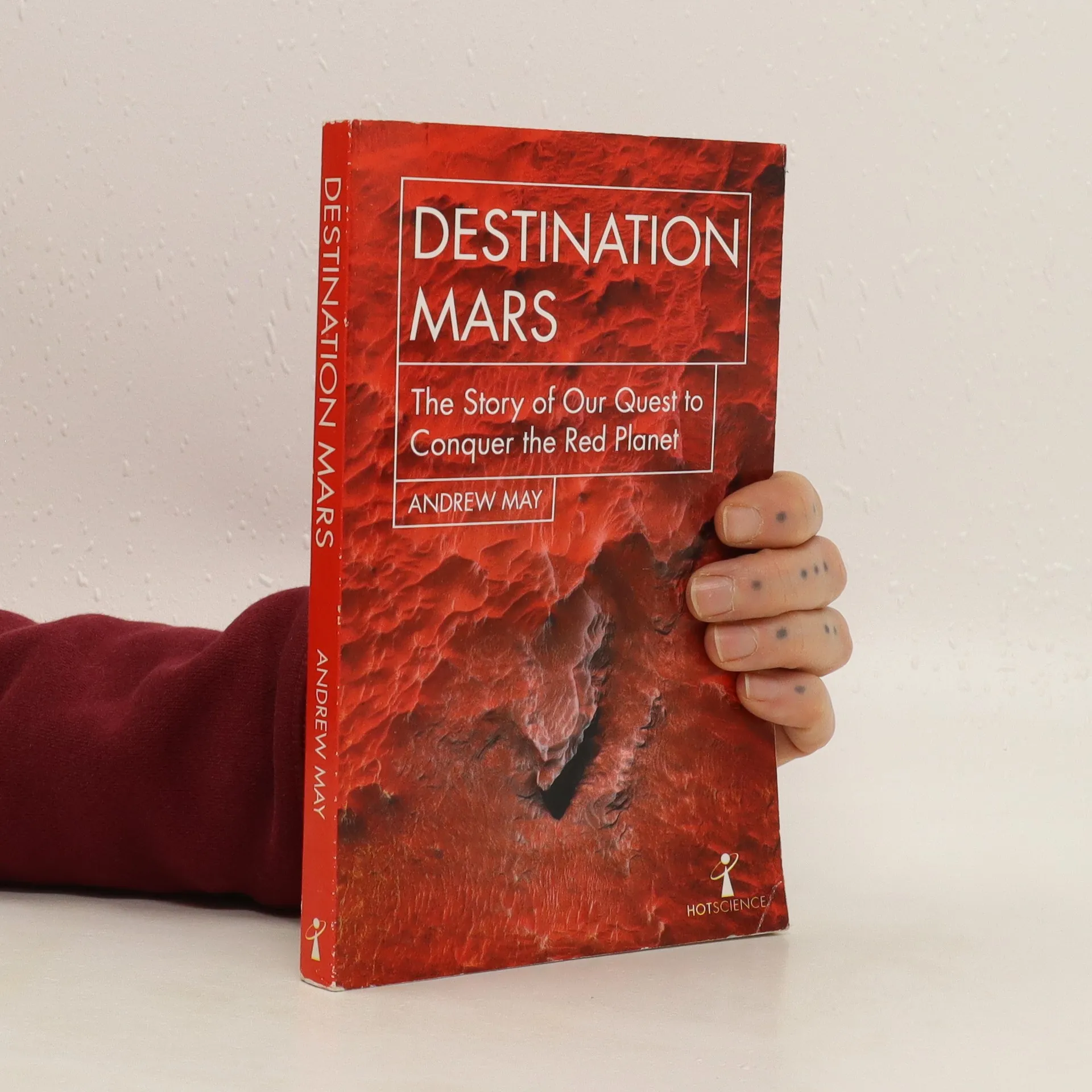
    Destination Mars
    • Destination Mars

      • 176 Seiten
      • 7 Lesestunden
      4,1(141)Abgeben

      Astrophysicist and science writer Andrew May traces the history of mankind's fascination with the Red Planet. The first book in Icon's new Hot Science series, exploring the cutting edge topics in science and technology.

      Destination Mars
    • The Space Business

      • 176 Seiten
      • 7 Lesestunden
      3,9(57)Abgeben

      Dreams, schemes and opportunity as space opens for tourism and commerce. Twentieth century space exploration may have belonged to state-funded giants such as NASA, but there is a parallel history which has set the template for the future. Even before Apollo 11 landed on the Moon, private companies were exploiting space via communication satellites - a sector that is seeing exponential growth in the internet age. In human spaceflight, too, commercialisation is making itself felt. Billionaire entrepreneurs Elon Musk, Jeff Bezos and Richard Branson have long trumpeted plans to make space travel a possibility for ordinary people and those ideas are inching ever closer to reality. At the same time, other companies plan to mine the Moon for helium-3, or asteroids for precious metals. Science writer Andrew May takes an entertaining, in-depth look at the triumphs and heroic failures of our quixotic quest to commercialise the final frontier.

      The Space Business
    • The possibility that alien life exists in the universe is among the most profound of human conjectures, which today is being investigated not just by science-fiction writers but by scientists.

      Astrobiology
    • The Science of Music

      • 176 Seiten
      • 7 Lesestunden
      3,5(40)Abgeben

      An investigation into the relationship between science and music - from Pythagoras to the Moog synthesizer. In this new title in Icon's Hot Science series, Andrew May traces how important science is in all aspects of music. After the basics of acoustic science and the history of sound waves, he explores how musicians have played with the scientific parameters of sound to apply algorithmic rules to create music. The role of science in music can be seen most obviously in the development of electronic technology, which has revolutionized how humans create, record and listen to music. The book also covers the complex world of brain science behind the creation of music, and the way we listen to and perceive it, and the frightening question of whether some form of AI would ever be able to create music on a par to that created by humans.

      The Science of Music
    • Miniature Sorption Coolers

      Theory and Applications

      • 217 Seiten
      • 8 Lesestunden

      Focusing on the practical application of refrigeration technology, this book offers comprehensive guidance for designing and constructing miniature refrigerators. It covers both single shot and continuous coolers operating at temperatures of 1 K, 300 mK, and 100 mK. Additionally, it includes instructions for writing the necessary design software, making it a valuable resource for both theoretical understanding and hands-on experimentation in cryogenics.

      Miniature Sorption Coolers
    • The Science of Sci-Fi Music

      • 158 Seiten
      • 6 Lesestunden

      The 20th century saw radical changes in the way serious music is composed and produced, including the advent of electronic instruments and novel compositional methods such as serialism and stochastic music. Unlike previous artistic revolutions, this one took its cues from the world of science. Creating electronic sounds, in the early days, required a well-equipped laboratory and an understanding of acoustic theory. Composition became increasingly “algorithmic”, with many composers embracing the mathematics of set theory. The result was some of the most intellectually challenging music ever written – yet also some of the best known, thanks to its rapid assimilation into sci-fi movies and TV shows, from the electronic scores of Forbidden Planet and Dr Who to the other-worldly sounds of 2001: A Space Odyssey. This book takes a close look at the science behind "science fiction" music, as well as exploring the way sci-fi imagery found its way into the work of musicians like Sun Ra and David Bowie, and how music influenced the science fiction writings of Philip K. Dick and others.

      The Science of Sci-Fi Music
    • Artist Ugo Catani's 'A Summer Shower in Collins Street, 1889' sets the scene for walking the streets of Melbourne, imagining the everyday past and seeing the urban landscape with new eyes. Melbourne's streets frame the ever-changing throng. This award-winning book is a rich commentary on the growth and transformation of a great Australian city.

      Melbourne Street Life
    • How Space Physics Really Works

      Lessons from Well-Constructed Science Fiction

      There is a huge gulf between the real physics of space travel and the way it is commonly portrayed in movies and TV shows. That's not because space physics is difficult or obscure - most of the details were understood by the end of the 18th century - but because it can often be bafflingly counter-intuitive for a general audience.

      How Space Physics Really Works
    • Over 50 years ago, astronomers launched the world's first orbiting telescope. This allowed them to gaze further into outer space and examine anything that appears in the sky above our heads, from comets and planets to galaxy clusters and stars. Since then, almost 100 space telescopes have been launched from Earth and are orbiting our planet, with 26 still active and relaying information back to us. As a result of these space-based instruments, such as NASA's iconic Hubble Space Telescope, we know much more about the universe than we did half a century ago. But why is Hubble, orbiting just 540 kilometres above the Earth, so much more effective than a ground-based telescope? How can a glorified camera tell us not only what distant objects look like, but their detailed chemical composition and three-dimensional structure as well? In Eyes in the Sky, science writer Andrew May takes us on a journey into space to answer these questions and more. Looking at the development of revolutionary instruments, such as Hubble and the James Webb Space Telescope, May explores how such technology has helped us understand the evolution of the Universe.

      Eyes in the Sky
    • When the amphibious Duplex Drive (DD) Sherman tanks of the 13th/18th Royal Hussars (QMO) touched down on the sand of Sword Beach as the vanguard of the D-Day invasion, ahead of the infantry and Commandos, it was the culmination of an evolution spanning several years. Switching roles from a mounted regiment in India, into a mechanised, armoured cavalry regiment, they fought in France in 1940, then faced an uncertain future, after evacuating through Dunkirk.However, the 13th/18th would subsequently be selected to spearhead the assault on Sword Beach in new, top secret amphibious tanks. Having successfully secured the beach on D-Day, the Regiment became heavily engaged in the battle for Normandy, earning themselves an excellent reputation with the infantry brigades which they supported, before pushing north into the Fatherland. Their casualties from D-Day onwards amounted to 142 Hussars lost, 236 wounded, with many gallantry awards received.In addition to recording the Regiment's achievements during World War II, the story includes the personal testimonies of many of the Regiment's soldiers and officers throughout the war, along with many previously unpublished photographs.

      DD Sherman Tank Warriors