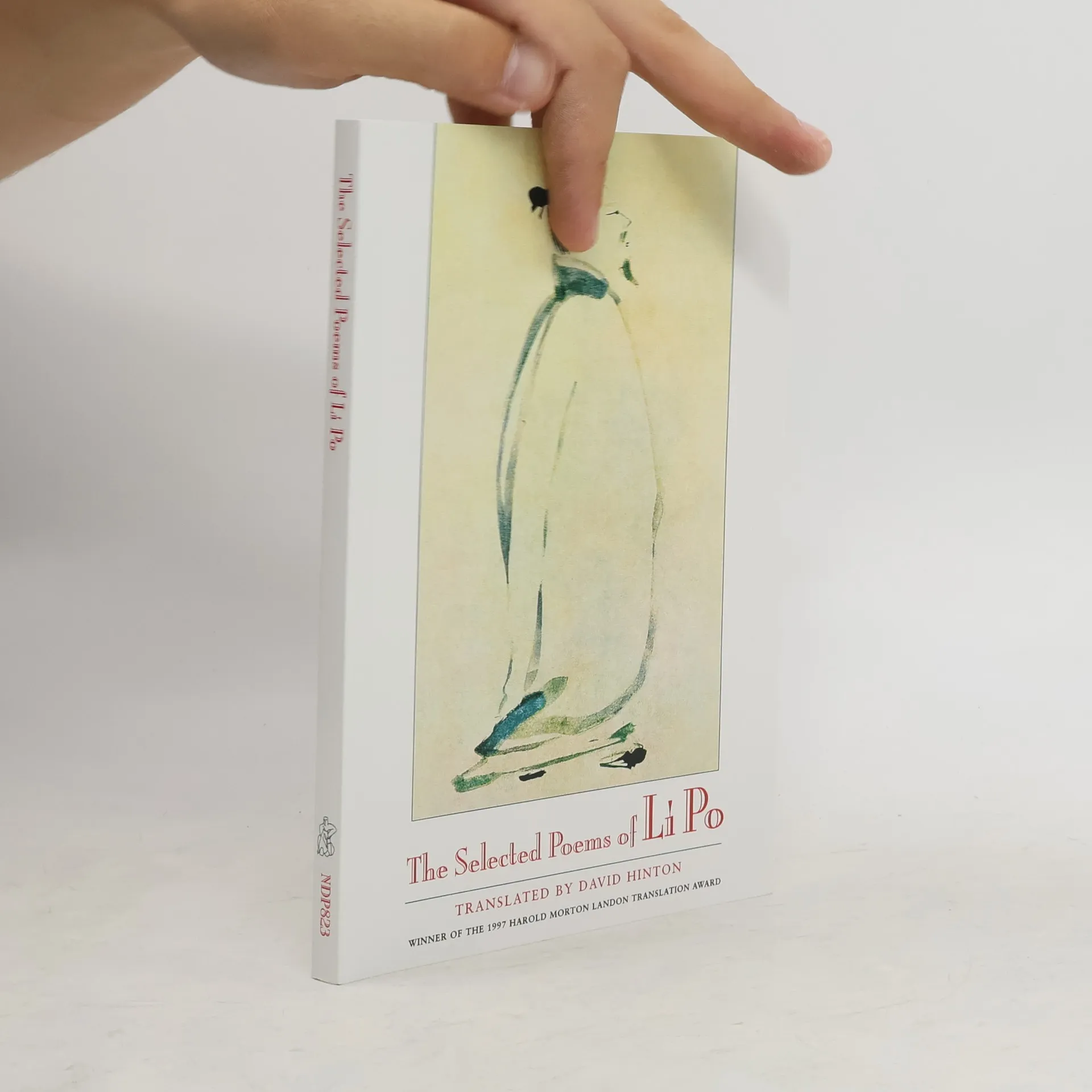
Li Po (A.D. 701-762) lived in T'ang Dynasty China, but his influence has spanned the centuries: the pure lyricism of his poems has awed readers in China and Japan for over a millennium, and through Ezra Pound's translations, Li Po became central to the modernist revolution in the West. His work is suffused with Taoism and Ch'an (Zen) Buddhism, but these seem not so much spiritual influences as the inborn form of his life
David Hinton Bücher

The Way of Ch'an
- 352 Seiten
- 13 Lesestunden
This sweeping collection of new translations paints a brilliant picture of the development of Ch’an (Zen) Buddhism, China’s most radical philosophical and meditative tradition. In this landmark anthology of some two dozen translations, celebrated translator David Hinton shows how Ch'an (Japanese: Zen)—too long considered a perplexing school of Chinese Buddhism—was in truth a Buddhist-inflected form of Taoism, China's native system of spiritual philosophy. The texts in The Way of Ch’an build from seminal Taoism through the “Dark-Enigma Learning” literature and on to the most important pieces from all stages of the classical Ch’an tradition. Guided by Hinton’s accessible introductions, readers will encounter texts and authors including: I Ching (c. 12th century BCE) Lao Tzu (c. 6th century BCE Bodhidharma (active c. 500-550 CE) Sixth Patriarch Prajna-Able (Hui Neng, 638-713) Cold Mountain (Han Shan: c. 8th-9th centuries) Yellow-Bitterroot Mountain (Huang Po, d. 850) Blue-Cliff Record (c. 1040) Through this steadily deepening and transformative reading experience, readers will see the profound and intricate connections between native Chinese philosophy, Taoism, and Ch’an. Contemporary Zen students and practitioners will never see their tradition in the same way again.
A once-in-a-generation translation of the definitive Ch’an (Zen) koan collection from preeminent translator David Hinton. The Blue-Cliff Record, a collection of Ch’an (Zen) koans stemming from the eleventh century, is a remarkable masterwork of classical Chinese literature, a philosophical text of profound power, and an active practice guide in use by Ch’an and Zen Buddhists all over the world. Rendered with his trademark lyricism and philosophical rigor, this new edition from renowned translator David Hinton presents a whole new Blue-Cliff Record. Full of poetry, storytelling, and characters both zany and profound, Hinton’s translation unveils the earthy insights of Ch’an’s original wisdom. Though it carries a reputation for impenetrable paradox, The Blue-Cliff Record was not meant to be a teaching tool understood only through long instruction from Zen masters. Rather, it is a finely crafted text intended to create a direct and immediate experience of awakening, a text that insists on the need to trust oneself rather than teachers for insight. Embracing this, Hinton’s translation presents only the original koans and poems, free of the commentaries that usually shroud it. In doing so, he rekindles the provocative and illuminating fire of these one hundred classic koans.
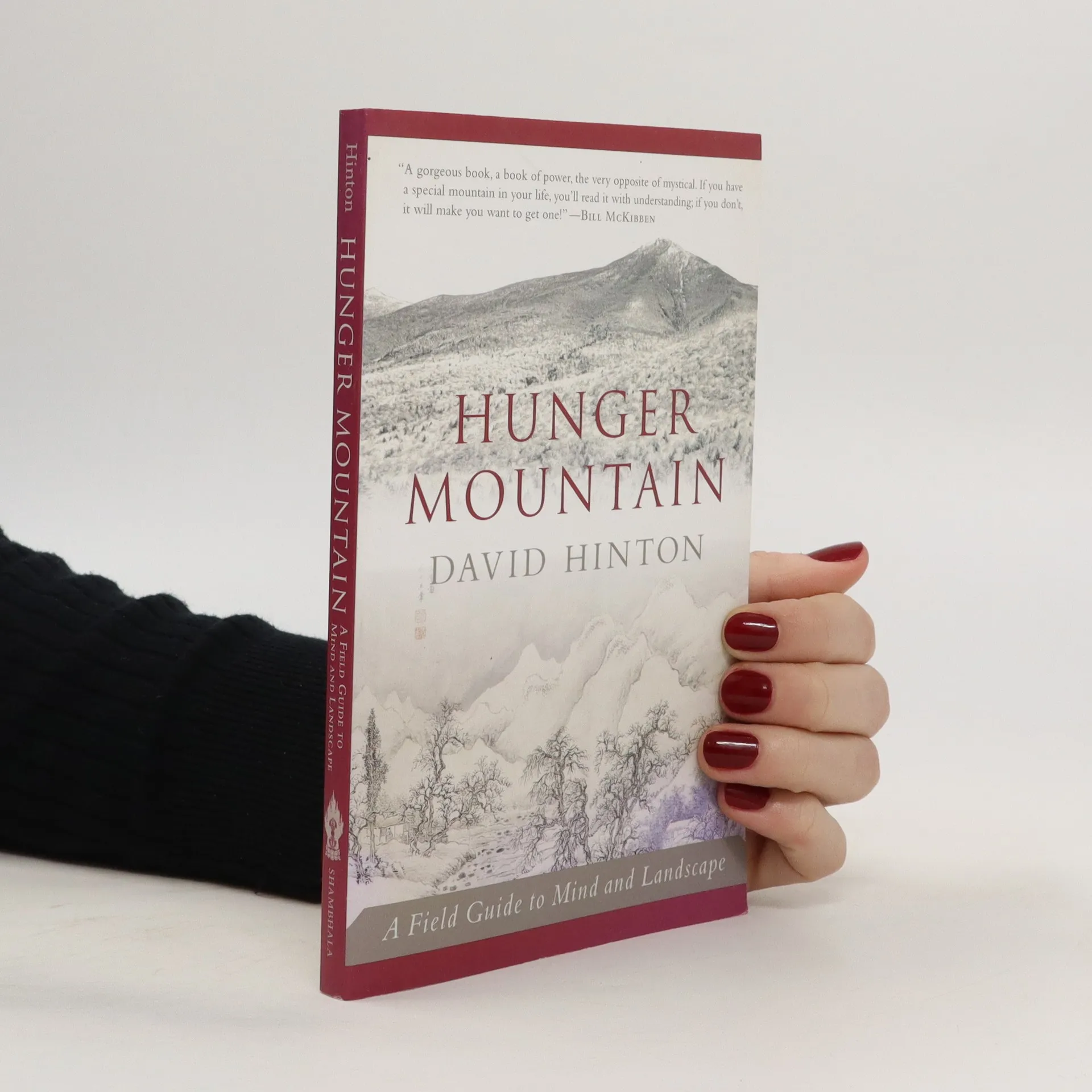
Hunger Mountain
- 144 Seiten
- 6 Lesestunden
Come along with David Hinton on a series of walks through the wild beauty of Hunger Mountain, near his home in Vermont—excursions informed by the worldview he’s imbibed from his many years translating the classics of Chinese poetry and philosophy. His broad-ranging discussion offers insight on everything from the mountain landscape to the origins of consciousness and the Cosmos, from geology to Chinese landscape painting, from parenting to pictographic oracle-bone script, to a family chutney recipe. It’s a spiritual ecology that is profoundly ancient and at the same time resoundingly contemporary. Your view of the landscape—and of your place in it—may never be the same.
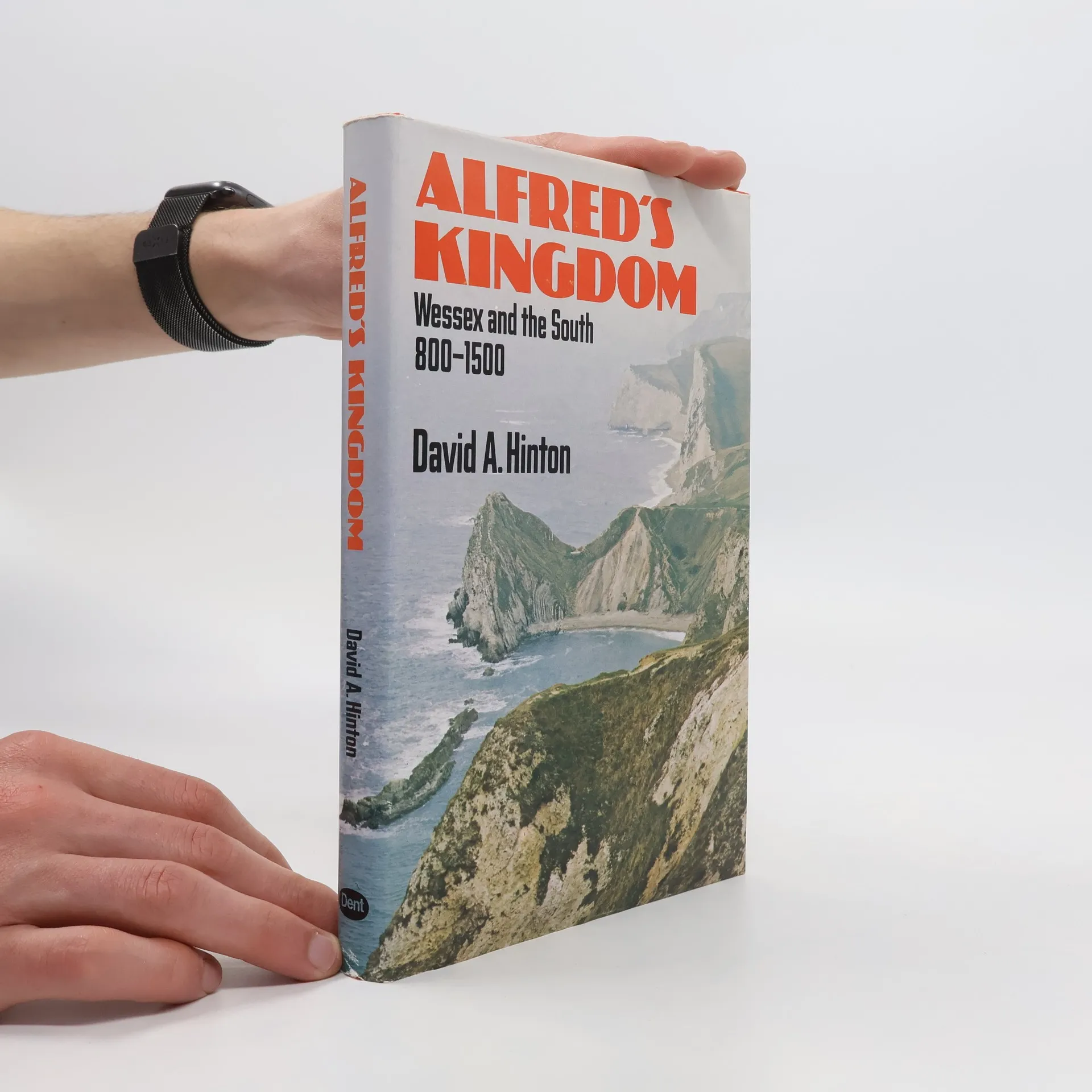
Alfred's Kingdom
- 228 Seiten
- 8 Lesestunden
The narrative invites readers on two journeys through the stunning landscapes and archaeological sites of the desert Southwest. Alongside the exploration of nature, the author delves into themes of consciousness and Taoist cosmology, blending the physical and philosophical realms. David Hinton's reflections offer a unique perspective on the interconnectedness of the environment and spiritual understanding.
Exploring the confluence of ancient Chinese spirituality and modern Western environmental thought, Wild Mind, Wild Earth reveals the unrecognized kinship of mind and nature that must be reanimated if we are to end our destruction of the planet. Earth is embroiled in its sixth major extinction event—this time caused not by asteroids or volcanos, but by us. At bottom, preventing this sixth extinction is a spiritual/philosophical problem, for it is the assumptions defining us and our relation to earth that are driving the devastation. Those assumptions insist on a fundamental separation of human and earth that devalues earth and enables our exploitative relation to it. In Wild Mind, Wild Earth, David Hinton explores modes of seeing and being that could save the planet by reestablishing a deep kinship between human and earth: the insights of primal cultures and the Ch’an (Zen) Buddhism of ancient China. He also shows how these insights have become well-established in the West over the last two hundred years, through the work of poets and philosophers and scientists. This offers marvelous hope and beauty—but like so many of us, Hinton recognizes the sixth extinction is now an inexorable and perhaps unstoppable tragedy. And he reveals how those primal/Zen insights enable us to inhabit even the unfurling catastrophe as a profound kind of liberation. Wild Mind, Wild Earth is a remarkable and revitalizing journey.
The Four Chinese Classics
- 544 Seiten
- 20 Lesestunden
Discover 4 seminal masterworks of Chinese thought—Lao Tzu’s Tao Te Ching, the Analects of Confucius, the Chuang Tzu, and the Mencius—presented in one volume for the first time in nearly 2 centuries. Award-winning translator David Hinton offers fresh insights on the most influential texts on Taoism, Zen Buddhism, Chinese philosophy, and more. Hinton’s award–winning experience translating a wide range of ancient Chinese poets makes these books sing in English as never before. But these new versions are not only inviting and immensely readable—they also apply much-needed consistency to key philosophical terms in these texts, lending structural links and philosophical rigor heretofore unavailable in English. Breathing new life into these classics, Hinton’s new translations will stand as the definitive texts for our era. Perhaps the most broadly influential spiritual text in human history, Lao Tzu’s Tao Te Ching is the source of Taoist philosophy, which eventually developed into Ch’an (Zen) Buddhism. Equally influential in the social sphere, Confucius’ Analects is the source of social wisdom in China. The Chuang Tzu is the wild and wacky prose complement to the Tao Te Ching. And with its philosophical storytelling, the Mencius adds depth and complexity to Confucius’ vision.
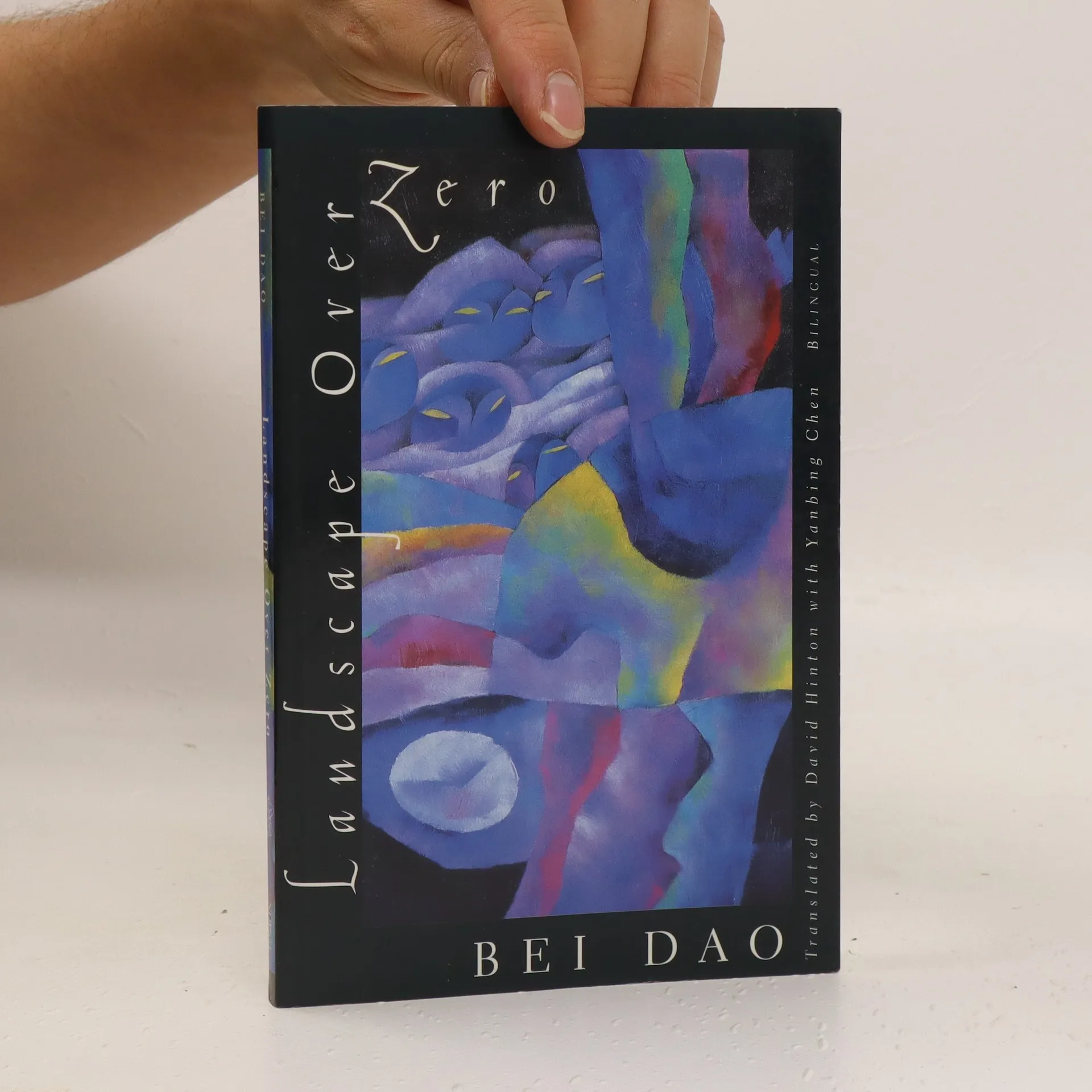
Landscape over zero
- 103 Seiten
- 4 Lesestunden
Collects fifty poems in both Chinese and English that reflect futility, distance, and the possibility of love's renewal.
China Root
- 176 Seiten
- 7 Lesestunden
"Ch'an (Zen) Buddhism emerged from the rich encounter of Indian Buddhism with Chinese Daoism. In this beautifully rendered literary meditation, renowned translator and author David Hinton illuminates anew the Chinese roots of Zen"-- Provided by publisher
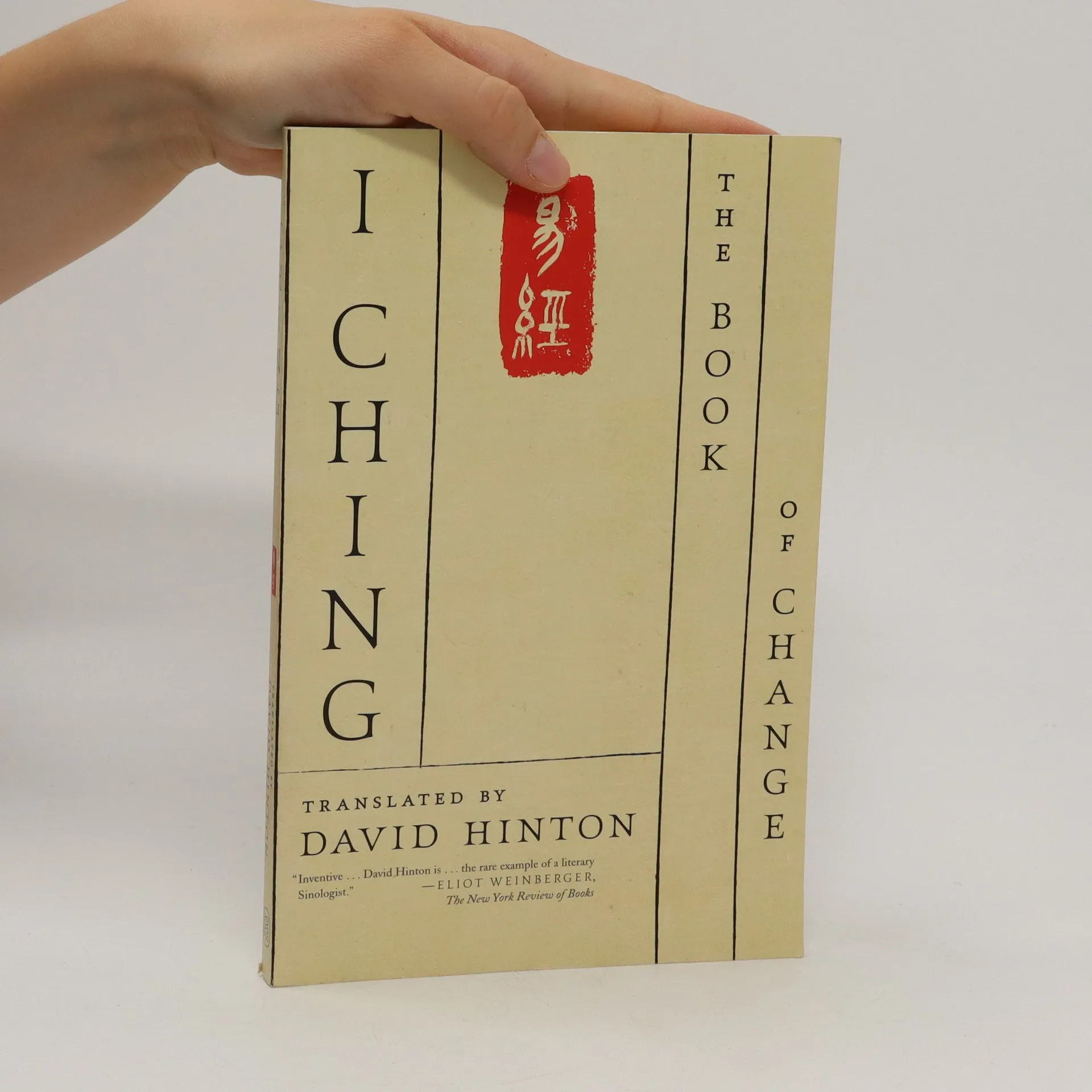
I ching.The book of change
- 160 Seiten
- 6 Lesestunden
A master translator's beautiful and accessible rendering of the seminal Chinese text In a radically new translation and interpretation of the I Ching, David Hinton strips this ancient Chinese masterwork of the usual apparatus and discovers a deeply poetic and philosophical text. Teasing out an elegant vision of the cosmos as ever-changing yet harmonious, Hinton reveals the seed from which Chinese philosophy, poetry, and painting grew. Although it was and is widely used for divination, the I Ching is also a book of poetic philosophy, deeply valued by artists and intellectuals, and Hinton's translation restores it to its original lyrical form. Previous translations have rendered the I Ching as a divination text full of arcane language and extensive commentary. Though informative, these versions rarely hint at the work's philosophical heart, let alone its literary beauty. Here, Hinton translates only the original strata of the text, revealing a fully formed work of literature in its own right. The result is full of wild imagery, fables, aphorisms, and stories. Acclaimed for the eloquence of his many translations of ancient Chinese poetry and philosophy, Hinton has reinvented the I Ching as an exciting contemporary text at once primal and postmodern.
Impinging on the Past
- 96 Seiten
- 4 Lesestunden
The prehistoric, Roman, and Anglo-Saxon periods were all represented in an excavation carried out in the centre of a Worcestershire village some time ago, but with results that can now be seen in new light because of all the archaeological work that has taken place since. A deep Iron Age ditch can be set in the context of enclosures revealed, mainly by air photography, of the gravel terraces in the river valleys of the Severn and Avon. The Romano-British skeletons form a small, elderly and hard-worked group, providing a contrast to the better-known large urban cemeteries. The growing of crops on an increasingly large scale has been demonstrated for the seventh to ninth centuries A.D., and at Fladbury the complex arrangements made to dry grain on what is known to have been a large and important estate show the resources put into feeding royal, aristocratic, and ecclesiastical households.