
This book represents Volume II of the Proceedings of the UN/ESA/NASA Workshop on the International Heliophysical Year 2007 and Basic Space Science, hosted by the National Astronomical Observatory of Japan, Tokyo, 18 - 22 June, 2007.
Astrophysics and Space Science Proceedings Reihe
Diese Publikationsreihe erfasst die neuesten Fortschritte in der Astrophysik und Weltraumforschung. Sie enthält detaillierte Beiträge von namhaften Spezialisten auf diesem Gebiet. Leser erhalten Einblicke in Spitzenforschung und theoretische Diskussionen. Sie ist eine unschätzbare Ressource für Forscher und Weltraumbegeisterte.


Empfohlene Lesereihenfolge
Dwarf galaxy research constitutes an extremely vibrant field of astrophysical research, with many long-standing questions still unsettled and new ones constantly arising. The intriguing diversity of the dwarf galaxy population, observed with advanced ground-based and space-borne observatories over a wide spectral window providing an unprecedented level of detail, poses new challenges for both observers and theoreticians. The aim of this symposium was to bring together these two groups to exchange ideas and new results on the many evolutionary aspects of and open issues concerning dwarf galaxies. The main topics addressed include: the birth of dwarf galaxies: theoretical concepts and observable relics across wavelengths and time, the morphological, structural and chemical evolution of dwarf galaxies, possible evolutionary connections between early-type and late-type dwarfs, the star formation history of dwarf galaxies and its dependence on intrinsic and environmental properties, the origin and implications of starburst activity in dwarf galaxies, the fate of dwarfish systems born out of tidally ejected matter in galaxy collisions.
The publication of the morphology - density relation by Alan Dressler in 1980 brought into the limelight the role played by environment in the formation and evolution of galaxies. The symposium Environment and the Formation of Galaxies: 30 years later, was organised with the purpose of establishing the environmental impact on the evolution of galaxies and its dependence on look-back time. Special emphasis was placed on the physical mechanisms that are responsible for transforming galaxies once they are accreted by a group or a cluster, including the observable imprint left in the galaxy HI distribution. Other major topics of the symposium were the environmental dependence of galaxy properties at z ≥ 1 and the implementation of environmental effects in cosmological models of galaxy formation and evolution. This book presents the edited proceedings of this stimulating meeting.
Proceedings of the Third UN/ESA/NASA Workshop on the International Heliophysical Year 2007 and Basic Space Science
National Astronomical Observatory of Japan
This book represents Volume II of the Proceedings of the UN/ESA/NASA Workshop on the International Heliophysical Year 2007 and Basic Space Science, hosted by the National Astronomical Observatory of Japan, Tokyo, 18 - 22 June, 2007. It covers two programme topics explored in this and past workshops of this nature: (i) non-extensive statistical mechanics as applicable to astrophysics, addressing q-distribution, fractional reaction and diffusion, and the reaction coefficient, as well as the Mittag-Leffler function and (ii) the TRIPOD concept, developed for astronomical telescope facilities. The companion publication, Volume I of the proceedings of this workshop, is a special issue in the journal Earth, Moon, and Planets, Volume 104, Numbers 1-4, April 2009.
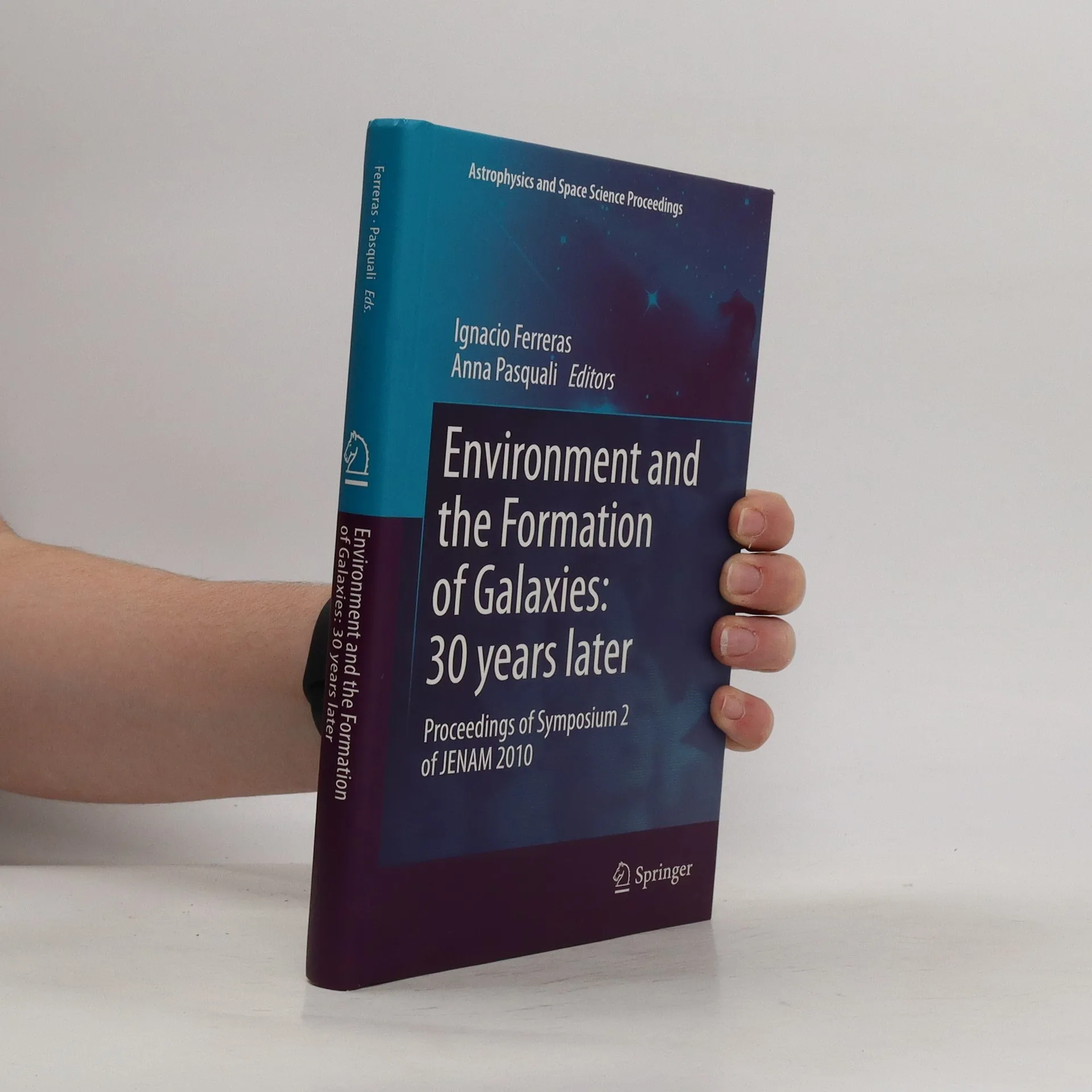
Environment and the Formation of Galaxies: 30 years later
Proceedings of Symposium 2 of JENAM 2010
The publication of the morphology - density relation by Alan Dressler in 1980 brought into the limelight the role played by environment in the formation and evolution of galaxies. The symposium Environment and the Formation of Galaxies: 30 years later , was organised with the purpose of establishing the environmental impact on the evolution of galaxies and its dependence on look-back time. Special emphasis was placed on the physical mechanisms that are responsible for transforming galaxies once they are accreted by a group or a cluster, including the observable imprint left in the galaxy HI distribution. Other major topics of the symposium were the environmental dependence of galaxy properties at z ≥ 1 and the implementation of environmental effects in cosmological models of galaxy formation and evolution. This book presents the edited proceedings of this stimulating meeting.
Dwarf Galaxies: Keys to Galaxy Formation and Evolution
Proceedings of Symposium 3 of JENAM 2010
- 368 Seiten
- 13 Lesestunden
Dwarf galaxy research constitutes an extremely vibrant field of astrophysical research, with many long-standing questions still unsettled and new ones constantly arising. The intriguing diversity of the dwarf galaxy population, observed with advanced ground-based and space-borne observatories over a wide spectral window providing an unprecedented level of detail, poses new challenges for both observers and theoreticians. The aim of this symposium was to bring together these two groups to exchange ideas and new results on the many evolutionary aspects of and open issues concerning dwarf galaxies. The main topics addressed include: the birth of dwarf galaxies: theoretical concepts and observable relics across wavelengths and time, the morphological, structural and chemical evolution of dwarf galaxies, possible evolutionary connections between early-type and late-type dwarfs, the star formation history of dwarf galaxies and its dependence on intrinsic and environmental properties, the origin and implications of starburst activity in dwarf galaxies, the fate of dwarfish systems born out of tidally ejected matter in galaxy collisions.