
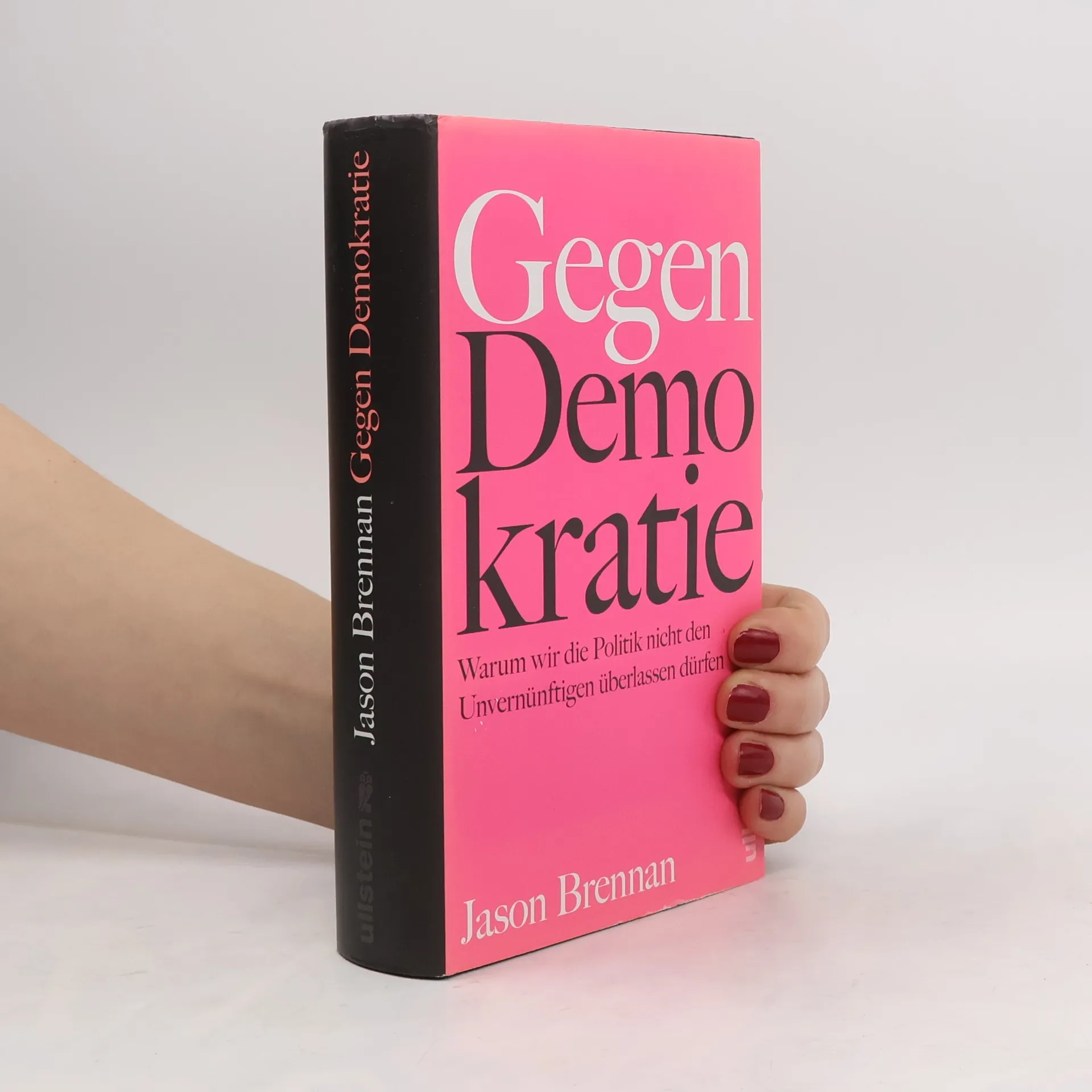
Jason Brennan erhebt eine provokante Forderung: Die Demokratie soll endlich nach ihren Ergebnissen beurteilt werden. Und die sind keineswegs überzeugend. Demokratie führt oft dazu, dass lautstarke Meinungsmacher den Bürgern ihre fatalen Entscheidungen aufzwingen. Zumal die Mehrheit der Wähler uninformiert ist, grundlegende ökonomische und politische Zusammenhänge nicht begreift, aber dennoch maßgeblich Einfluss auf die Politik ausübt. Wir sollten anerkennen, dass das Wahlrecht kein universales Menschenrecht ist, sondern nur verantwortungsvollen, informierten Menschen mit politischen Kompetenzen zusteht. Mit Verve und anhand prägnanter Beispiele zeigt Brennan, dass eine gemäßigte Epistokratie – eine Herrschaft der Wissenden – die sinnvollere Regierungsform im 21. Jahrhundert ist.

Jason Brennan Bücher
Jason Brennan beschäftigt sich mit Ethik, Wirtschaft und öffentlicher Politik. Seine Arbeit untersucht die philosophischen Grundlagen von Gesellschaft und Politik und erforscht, wie sowohl Einzelpersonen als auch Institutionen moralischer handeln können. Mit seinen Schriften möchte er tiefere Reflexionen über komplexe Themen anregen und die Leser ermutigen, aufgeklärtere Lösungen zu suchen.


Good Work If You Can Get It
- 192 Seiten
- 7 Lesestunden
Read it, and you will come away ready to hit the ground running.
Business Ethics for Better Behavior
- 288 Seiten
- 11 Lesestunden
A clear and concise roadmap for ethical business behavior using commonsense moral principlesBusiness Ethics for Better Behavior concisely answers the three most pressing ethical questions business professionals What makes business practices right or wrong?; Why do normal, decent businesspeople of good will sometimes do the wrong thing?; and How can we use the answer to these questions to get ourselves, our coworkers, our bosses, and our employees to behave better?Bad behavior in business rarely results from bad will. Most people mean well much of the time. But most of us are vulnerable. We all fall into moral traps, usually without even noticing.Business Ethics for Better Behavior teaches business professionals, students, and other readers how to become aware of those traps, how to avoid them, and how to dig their way out if they fall in. It integrates the best work in psychology, economics, management theory, and normative philosophy into a simple action plan for ensuring the best ethical performance at all levels of business practice. This is a book anyone in business, from an entry-level employee to CEO, can use.
Why It's OK to Want to Be Rich
- 184 Seiten
- 7 Lesestunden
Jason Brennan presents a compelling argument that aspiring to wealth and enjoying the benefits of being rich are not only acceptable but also positive pursuits. He challenges societal norms around wealth and encourages readers to embrace their desires for financial success without guilt. Through his insights, he aims to reshape the conversation about money, highlighting its potential to enhance life experiences and promote personal freedom.
When All Else Fails
- 288 Seiten
- 11 Lesestunden
The economist Albert O. Hirschman famously argued that citizens of democracies have only three possible responses to injustice or wrongdoing by their government: we may leave, complain, or comply. But in When All Else Fails, Jason Brennan argues that there is fourth option. When governments violate our rights, we may resist. We may even have a moral duty to do so. For centuries, almost everyone has believed that we must allow the government and its representatives to act without interference, no matter how they behave. We may complain, protest, sue, or vote officials out, but we can't fight back. But Brennan makes the case that we have no duty to allow the state or its agents to commit injustice. We have every right to react with acts of "uncivil disobedience." We may resist arrest for violation of unjust laws. We may disobey orders, sabotage government property, or reveal classified information. We may deceive ignorant, irrational, or malicious voters. We may even use force in self-defense or to defend others. The result is a provocative challenge to long-held beliefs about how citizens may respond when government officials behave unjustly or abuse their power
In this expanded 2nd edition, Brennan responds to his critics throughout the book and provides two new, final chapters.
Against Democracy
- 288 Seiten
- 11 Lesestunden
"Most people believe democracy is a uniquely just form of government. They believe people have the right to an equal share of political power. And they believe that political participation is good for us - it empowers us, helps us get what we want, and tends to make us smarter, more virtuous, and more caring for one another. These are some of our most cherished ideas about democracy. But, Jason Brennan says, they are all wrong. In this trenchant book, Brennan argues that democracy should be judged by its results - and the results are not good enough. Just as defendants have a right to a fair trial, citizens have a right to competent government. But democracy is the rule of the ignorant and the irrational, and it all too often falls short. Furthermore, no one has a fundamental right to any share of political power, and exercising political power does most of us little good. On the contrary, a wide range of social science research shows that political participation and democratic deliberation actually tend to make people worse - more irrational, biased, and mean. Given this grim picture, Brennan argues that a new system of government - epistocracy, the rule of the knowledgeable, may be better than democracy, and that it's time to experiment and find out"--Jacket sleeve.
Debating Democracy
- 256 Seiten
- 9 Lesestunden
Around the world, faith in democracy is falling. Russia, Turkey, and Venezuela have moved from flawed democracies to authoritarian regimes. Brexit and the rise of far-right parties show that even stable Western democracies are struggling. Partisanship and mutual distrust are increasing. What, if anything, should we do about these problems? In this accessible work, leading philosophers Jason Brennan and H�l�ne Landemore debate whether the solution lies in having less democracy or more.Brennan argues that democracy has systematic flaws, and that democracy does not and cannot work the way most of us commonly assume. He argues the best solution is to limit democracy's scope and to experiment with certain voting systems that can overcome democracy's problems.Landemore argues that democracy, defined as a regime that distributes power equally and inclusively, is a better way to generate good governance than oligarchies of knowledge. To her, the crisis of "representative democracy" comes in large part from its glaring democratic deficits. The solution isnot just more democracy, but a better kind, which Landemore theorizes as "open democracy."
Democracy
- 334 Seiten
- 12 Lesestunden
Democracy: A Guided Tour gives readers a crash course on the evolution of the idea of democracy, how it has been and is currently practiced, and how we might think about it as we head into a new chapter in its story.
Proti demokracii
- 330 Seiten
- 12 Lesestunden
Autor v této kontroverzní knize tvrdí, že demokracie by měla být posuzována podle svých výsledků – a ty nejsou dostatečně dobré. Stejně jako mají obžalovaní právo na spravedlivý proces, mají občané právo na kompetentní vládu. Vinou toho, jak je nastaven systém voleb politického vedení, stávají se demokracie stále častěji vládou neznalých a iracionálně rozhodujících politiků, a příliš často selhávají. Podíl na politické moci většině voličů přináší jen málo užitku. Celá řada sociálněvědních výzkumů ukazuje, že možnost politické účasti paradoxně činí nezanedbatelnou část voličů iracionálnější a zaujatější. Vzhledem k tomuto chmurnému zjištění Brennan tvrdí, že nový systém vlády, který nazývá epistokracie neboli vláda znalých, může být lepším systémem než demokracie a že je možná na čase začít s tímto nápadem experimentovat.