

Among the few truly experimental composers in our cultural history, Harry Partch's life (1901-1974) and music embody most completely the quintessential American rootlessness, isolation, pre-civilized cult of experience, and dichotomy of practical invention and transcendental visions. Having lived mostly in the remote deserts of Arizona and New Mexico with no access to formal training, Partch naturally created theatrical ritualistic works incorporating Indian chants, Japanese kabuki and Noh, Polynesian microtones, Balinese gamelan, Greek tragedy, dance, mime, and sardonic commentary on Hollywood and commercial pop music of modern civilization. First published in 1949, Genesis of a Music is the manifesto of Partch's radical compositional practice and instruments (which owe nothing to the 300-year-old European tradition of Western music.) He contrasts Abstract and Corporeal music, proclaiming the latter as the vital, emotionally tactile form derived from the spoken word (like Greek, Chinese, Arabic, and Indian musics) and surveys the history of world music at length from this perspective. Parts II, III, and IV explain Partch's theories of scales, intonation, and instrument construction with copious acoustical and mathematical documentation. Anyone with a musically creative attitude, whether or not familiar with traditional music theory, will find this book revelatory.
Harry Partch Bücher
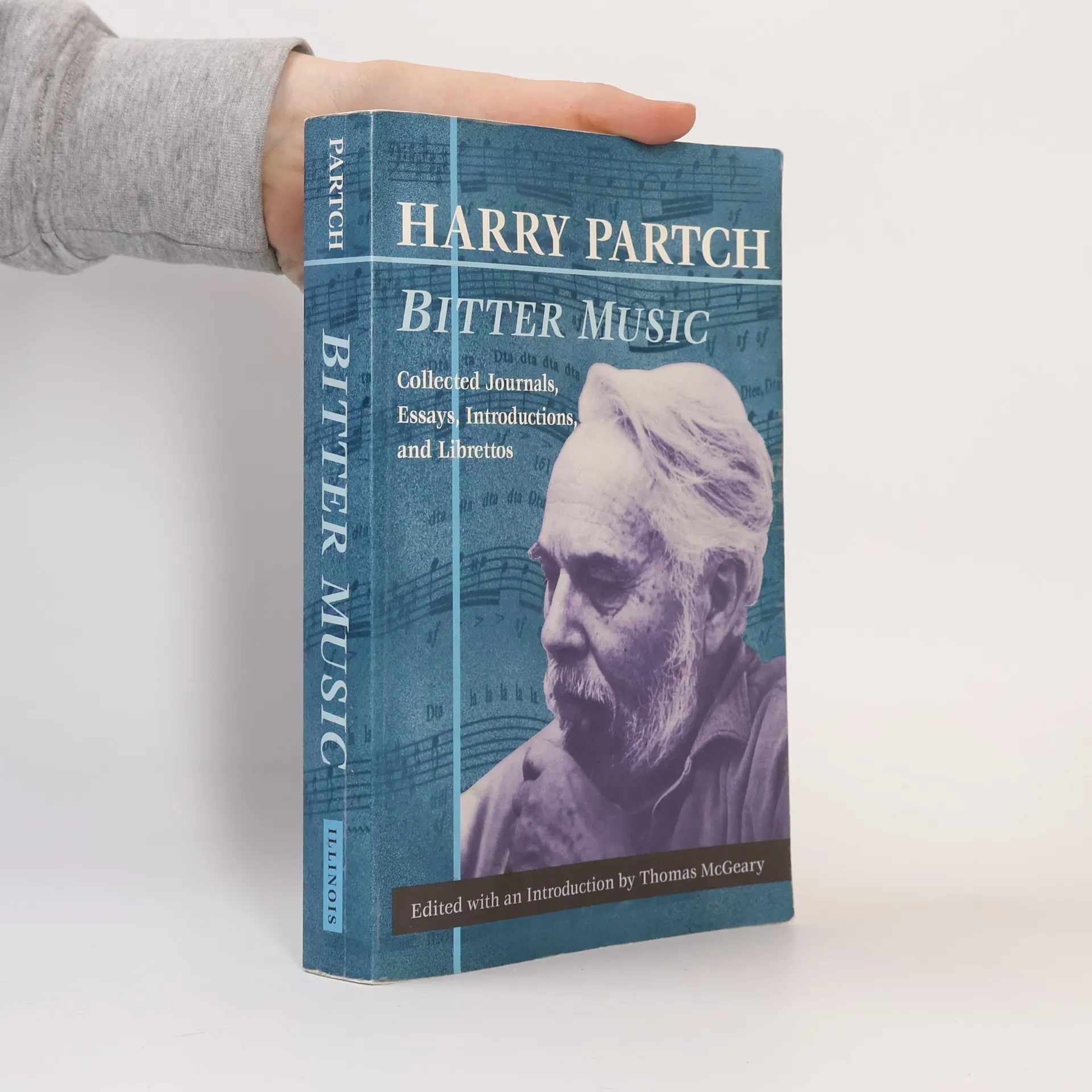

Music in American Life: Bitter Music
Collected Journals, Essays, Introductions, and Librettos
- 520 Seiten
- 19 Lesestunden
Harry Partch was an innovative composer who embraced just intonation, leading him to create new instruments for his unique forty-three-tone scale. The anthology explores his views on music's societal role, his compositions, and his distinctive instruments. It begins with "Bitter Music," a journal from his time as a transient in the American West during the Depression, which he believed lost. This deeply personal account offers vital biographical insights into a pivotal period in his life, revealing the insecurities of his career marked by fluctuating institutional support and economic challenges. As a significant work of American Depression literature, the journal uniquely features musically notated speech along with folk and popular music. The second journal, "End Littoral," chronicles a hiking trip along California's rugged coast. The collection includes twelve essays that present Partch's thought-provoking analysis of music's relationship with society, with two essays published for the first time, while the others appeared in obscure publications from 1941 to 1972. Additionally, it features twelve extended discussions by Partch on his compositions, with ten being previously unpublished. The anthology concludes with librettos or scenarios for six of his major narrative or dramatic works.