

This book is a study of discourse-the flow of talk-of schizophrenic speakers. Our goal is to understand the processes which account for the ordinary flow of talk that happens all the time between speakers and lis teners. How do conversations happen? What is needed by a listener to follow a speaker's words and respond appropriately to them? How much can a speaker take for granted and how much must be stated explicitly for the listener to follow the speaker's meanings readily and easily? Each time we ask these questions, we seem to have to go back to some place prior to the "ordinary" adult conversation. This time, we have tried reversing the questions and What happens when conversa tion fails? Prompted in part by an early paper by Robin Lakoff to the Chi cago Linguistics Society and by Herb Clark's studies of listener processes, we wondered what a speaker has to do to make the listener finally stop making allowances and stop trying to adjust the conversational contract to cooperate. This inquiry led us to the schizophrenic speaker. When a listener decides that the speaker's talk is "crazy," he or she is giving up on the normal form of conversation and saying, in effect, this talk is ex traordinary and something is wrong. We thought that, if we could specify what makes a conversation fail, we might learn what has to be present for a conversation to succeed.
J. R. Martin Bücher
Die gebürtige Texanerin J.R. Martin, Autorin von über zehn Büchern, lebt auf einer texanischen Ranch, wo sie oft bis spät in die Nacht arbeitet, während ihre Charaktere zum Leben erwachen. Sie liebt es, eine Wortkünstlerin zu sein und erlebt die Welt und ihre Abenteuer durch die Augen ihrer fiktiven Schöpfungen. Martin erzählt, dass es eine tiefe Freude ist, die Welt durch ihre geliebten Charaktere zu sehen, und dass es ihr das Herz bricht, wenn sie einen Charakter sterben lassen muss.
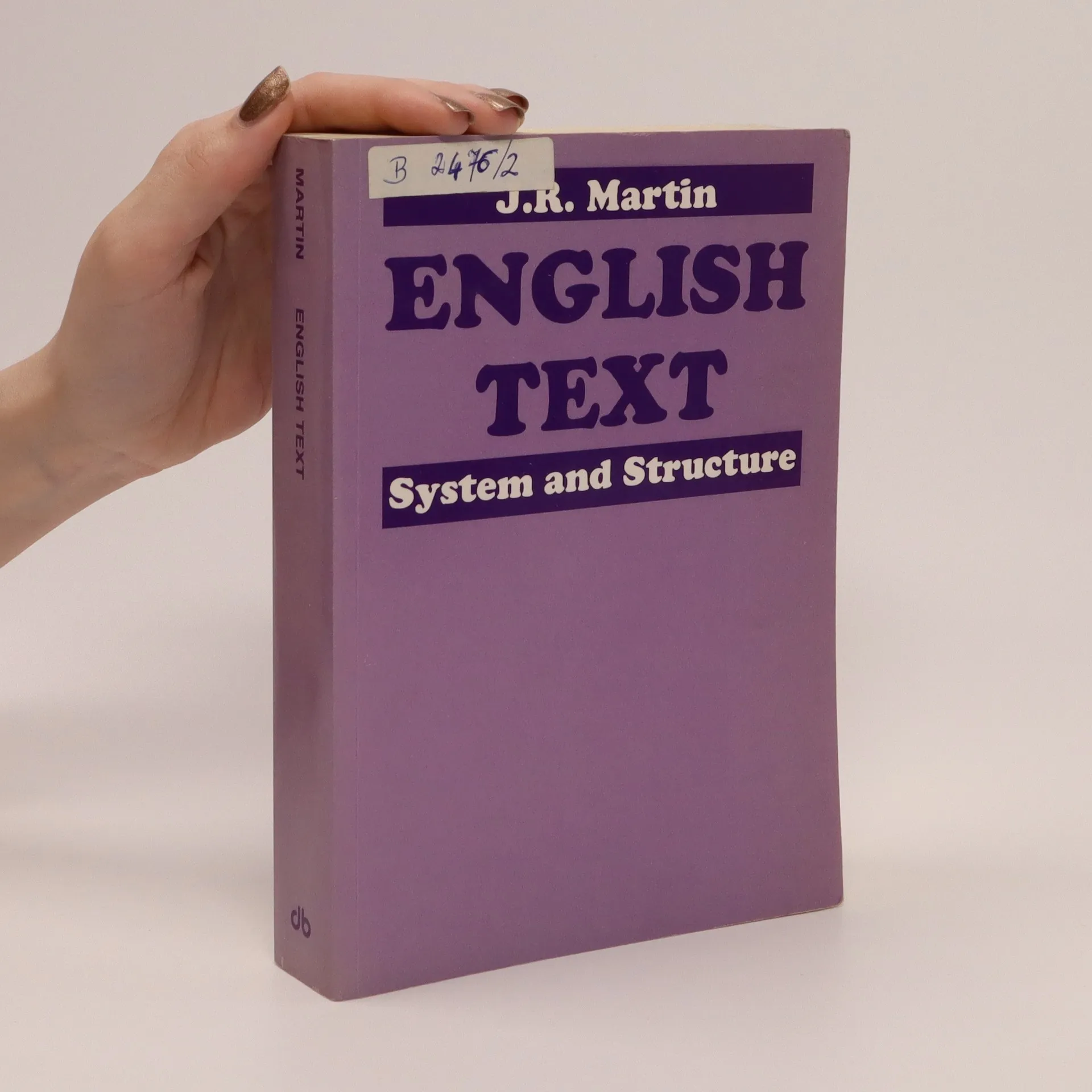

English text: system and structure
- 634 Seiten
- 23 Lesestunden
This book is a comprehensive introduction to text forming resources in English, along with practical procedures for analysing English texts and relating them to their contexts of use. It has been designed to complement functional grammars of English, building on the generation of discourse analysis inspired by Halliday and Hasan's Cohesion in English. The analyses presented were developed within three main theoretical and applied contexts: (i) educational linguistics (especially genre-based literacy programmes) (ii) critical linguistics (as manifested in the development of social semiotics) and (iii) computational linguistics (in dialogue with the various text generation projects based on systemic approaches to grammar and discourse). English Text's major contribution is to outline one way in which a rich semantically oriented functional grammar can be systematically related to a theory of discourse semantics, including deconstruction of contextual issues (i.e. register, genre and ideology). The chapters have been organized with the needs of undergraduate students in theoretical linguistics and postgraduate students in applied linguistics in mind.