



Mehr zum Buch
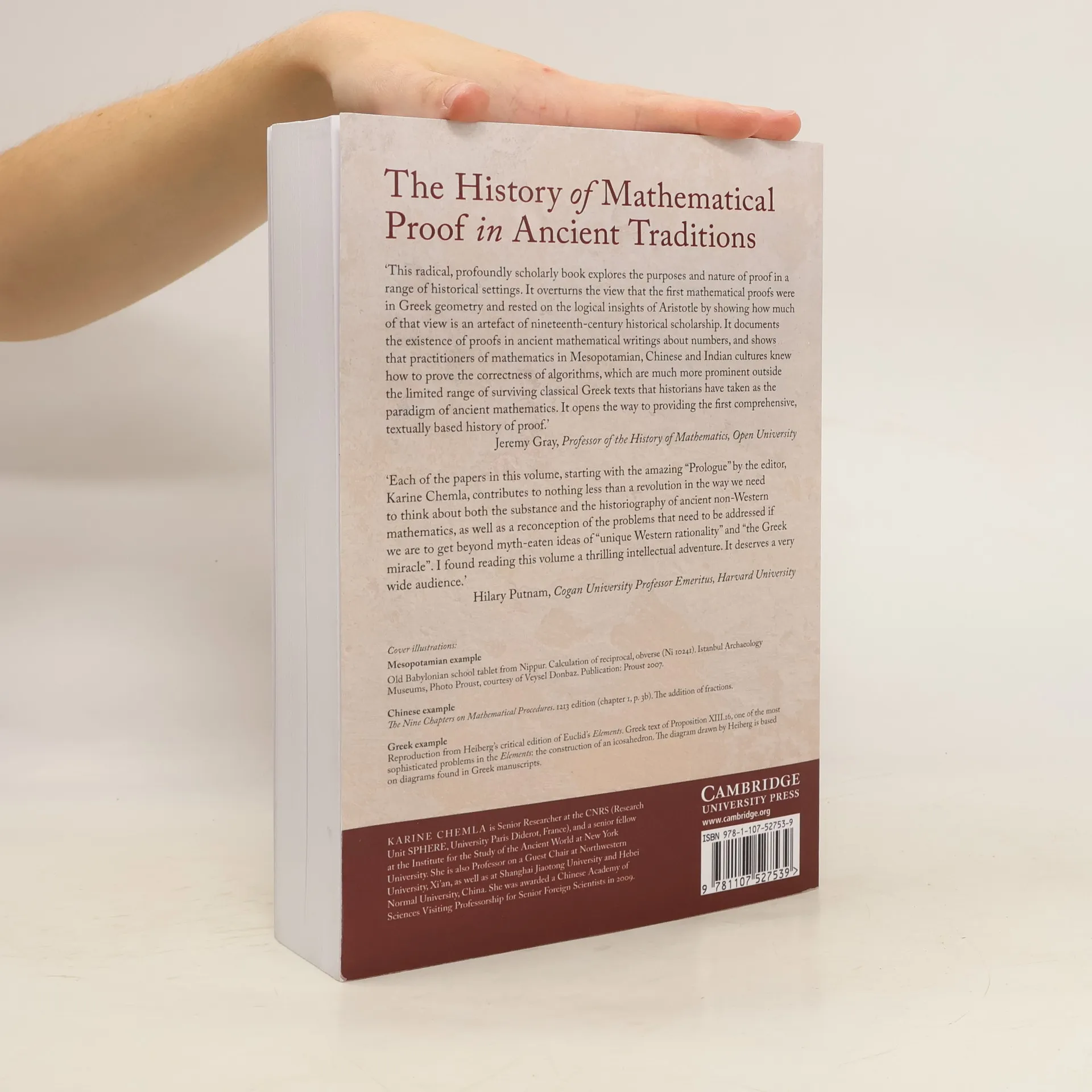
This radical, profoundly scholarly book explores the purposes and nature of proof in a range of historical settings. It overturns the view that the first mathematical proofs were in Greek geometry and rested on the logical insights of Aristotle by showing how much of that view is an artefact of nineteenth-century historical scholarship. It documents the existence of proofs in ancient mathematical writings about numbers and shows that practitioners of mathematics in Mesopotamian, Chinese and Indian cultures knew how to prove the correctness of algorithms, which are much more prominent outside the limited range of surviving classical Greek texts that historians have taken as the paradigm of ancient mathematics. It opens the way to providing the first comprehensive, textually-based history of proof.
Buchkauf
The History of Mathematical Proof in Ancient Traditions, Karine Chemla
- Sprache

- Erscheinungsdatum
- 2015
- Einband
- (Paperback)
Keiner hat bisher bewertet.
- Titel
- The History of Mathematical Proof in Ancient Traditions
- Sprache
- Englisch
- Autor*innen
- Karine Chemla
- Erscheinungsdatum
- 2015
- Einband
- Paperback
- Seitenzahl
- 614
- ISBN10
- 1107527538
- ISBN13
- 9781107527539
- Reihe
- Schlagwörter
- Beschreibung
- This radical, profoundly scholarly book explores the purposes and nature of proof in a range of historical settings. It overturns the view that the first mathematical proofs were in Greek geometry and rested on the logical insights of Aristotle by showing how much of that view is an artefact of nineteenth-century historical scholarship. It documents the existence of proofs in ancient mathematical writings about numbers and shows that practitioners of mathematics in Mesopotamian, Chinese and Indian cultures knew how to prove the correctness of algorithms, which are much more prominent outside the limited range of surviving classical Greek texts that historians have taken as the paradigm of ancient mathematics. It opens the way to providing the first comprehensive, textually-based history of proof.