


Gratis Versand ab € 14,99. Mehr Infos.
Bookbot

Adaptive Berechnung und maschinelles Lernen

Diese Reihe befasst sich mit der komplexen Welt der adaptiven Berechnungen und des maschinellen Lernens. Sie untersucht verschiedene Techniken, die Systeme befähigen, aus Erfahrung zu lernen und sich an neue Umgebungen anzupassen. Leser erhalten Einblicke in theoretische Rahmenwerke und Innovationen in der algorithmischen Entwicklung. Die Sammlung fördert ein tieferes Verständnis und die praktische Anwendung dieses sich schnell entwickelnden Gebiets.

Machine Learning
Reinforcement Learning
Deep learning
Principles of Data Mining
Maschinelles Lernen
  • Maschinelles Lernen heißt, Computer so zu programmieren, dass ein bestimmtes Leistungskriterium anhand von Beispieldaten und Erfahrungswerten aus der Vergangenheit optimiert wird. Das vorliegende Buch diskutiert diverse Methoden, die ihre Grundlagen in verschiedenen Themenfeldern haben: Statistik, Mustererkennung, neuronale Netze, Künstliche Intelligenz, Signalverarbeitung, Steuerung und Data Mining. In der Vergangenheit verfolgten Forscher verschiedene Wege mit unterschiedlichen Schwerpunkten. Das Anliegen dieses Buches ist es, all diese unterschiedlichen Ansätze zu kombinieren, um eine allumfassende Behandlung der Probleme und ihrer vorgeschlagenen Lösungen zu geben.

    Maschinelles Lernen
    3,6
  • Principles of Data Mining

    • 578 Seiten
    • 21 Lesestunden

    The first truly interdisciplinary text on data mining, blending the contributions of information science, computer science, and statistics.The growing interest in data mining is motivated by a common problem across disciplines: how does one store, access, model, and ultimately describe and understand very large data sets? Historically, different aspects of data mining have been addressed independently by different disciplines. This is the first truly interdisciplinary text on data mining, blending the contributions of information science, computer science, and statistics.The book consists of three sections. The first, foundations, provides a tutorial overview of the principles underlying data mining algorithms and their application. The presentation emphasizes intuition rather than rigor. The second section, data mining algorithms, shows how algorithms are constructed to solve specific problems in a principled manner. The algorithms covered include trees and rules for classification and regression, association rules, belief networks, classical statistical models, nonlinear models such as neural networks, and local memory-based models. The third section shows how all of the preceding analysis fits together when applied to real-world data mining problems. Topics include the role of metadata, how to handle missing data, and data preprocessing.

    Principles of Data Mining
    3,8
  • Deep learning

    • 864 Seiten
    • 31 Lesestunden

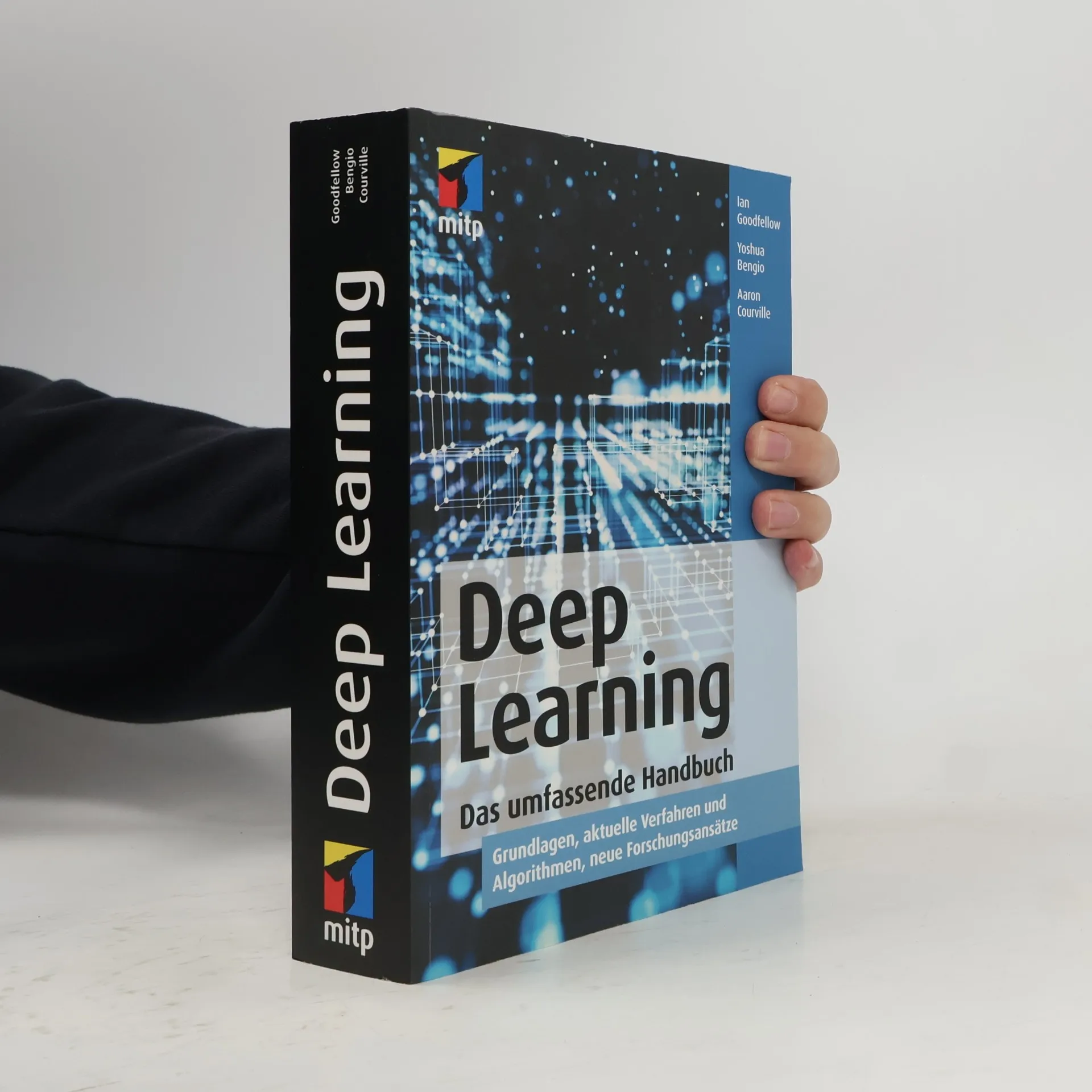
    Das Buch bietet eine umfassende Behandlung moderner Verfahren im Bereich des Deep Learning, einschließlich tiefer Feedforward-Netze, Regularisierung, Performance-Optimierung sowie Convolutional Neural Networks (CNNs) und rekurrenter neuronaler Netze. Es beleuchtet auch zukunftsweisende Ansätze und Konzepte wie Generative Adversarial Networks, die von Ian Goodfellow entwickelt wurden. Deep Learning, ein Teilbereich des Machine Learning, ermöglicht es Computern, aus Erfahrungen zu lernen. Der Inhalt ist in drei Teile gegliedert: Teil I behandelt die mathematischen Grundlagen für Künstliche Intelligenz, Neuronale Netze und Machine Learning, einschließlich linearer Algebra, Wahrscheinlichkeits- und Informationstheorie, bayesscher Statistik und numerischer Berechnung. Teil II fokussiert auf aktuelle Verfahren und Algorithmen, die in der Praxis eingesetzt werden, wie tiefe Feedforward-Netze, Regularisierung, Optimierung beim Training tiefer Modelle sowie Sequenzmodellierung. Teil III gibt Einblicke in aktuelle Forschungsansätze und innovative Verfahren, darunter lineare Faktorenmodelle, Autoencoder, probabilistische graphische Modelle und tiefe generative Modelle wie Restricted Boltzmann Machines und Variational Autoencoder. Das Buch richtet sich an Studierende, Forscher und Softwareentwickler mit Grundkenntnissen in Mathematik, Informatik und Programmierung, die Deep Learning für eigene Projekte nutzen möchten.

    Deep learning
    4,5
  • An account of key ideas and algorithms in reinforcement learning. The discussion ranges from the history of the field's intellectual foundations to recent developments and applications. Areas studied include reinforcement learning problems in terms of Markov decision problems and solution methods.

    Reinforcement Learning
    4,6
  • Machine Learning

    A Probabilistic Perspective

    • 1104 Seiten
    • 39 Lesestunden

    This comprehensive introduction to machine learning employs probabilistic models and inference as a unifying framework. The explosion of electronic data on the Web necessitates automated data analysis methods, and machine learning addresses this by developing techniques to automatically identify patterns and predict future data. The textbook presents a self-contained overview of the field, integrating essential background topics such as probability, optimization, and linear algebra, while also covering recent advancements like conditional random fields, L1 regularization, and deep learning. Written in an informal and accessible style, it includes pseudo-code for key algorithms, along with numerous color illustrations and worked examples from diverse fields like biology, text processing, computer vision, and robotics. Instead of merely presenting a variety of heuristic methods, the book emphasizes a principled model-based approach, often utilizing graphical models for clear and concise specification. Most models discussed are implemented in the freely available MATLAB software package, PMTK (probabilistic modeling toolkit). This resource is ideal for upper-level undergraduates with a basic college math background and beginning graduate students.

    Machine Learning
    4,4