


Parameter
- 115 Seiten
- 5 Lesestunden
Mehr zum Buch
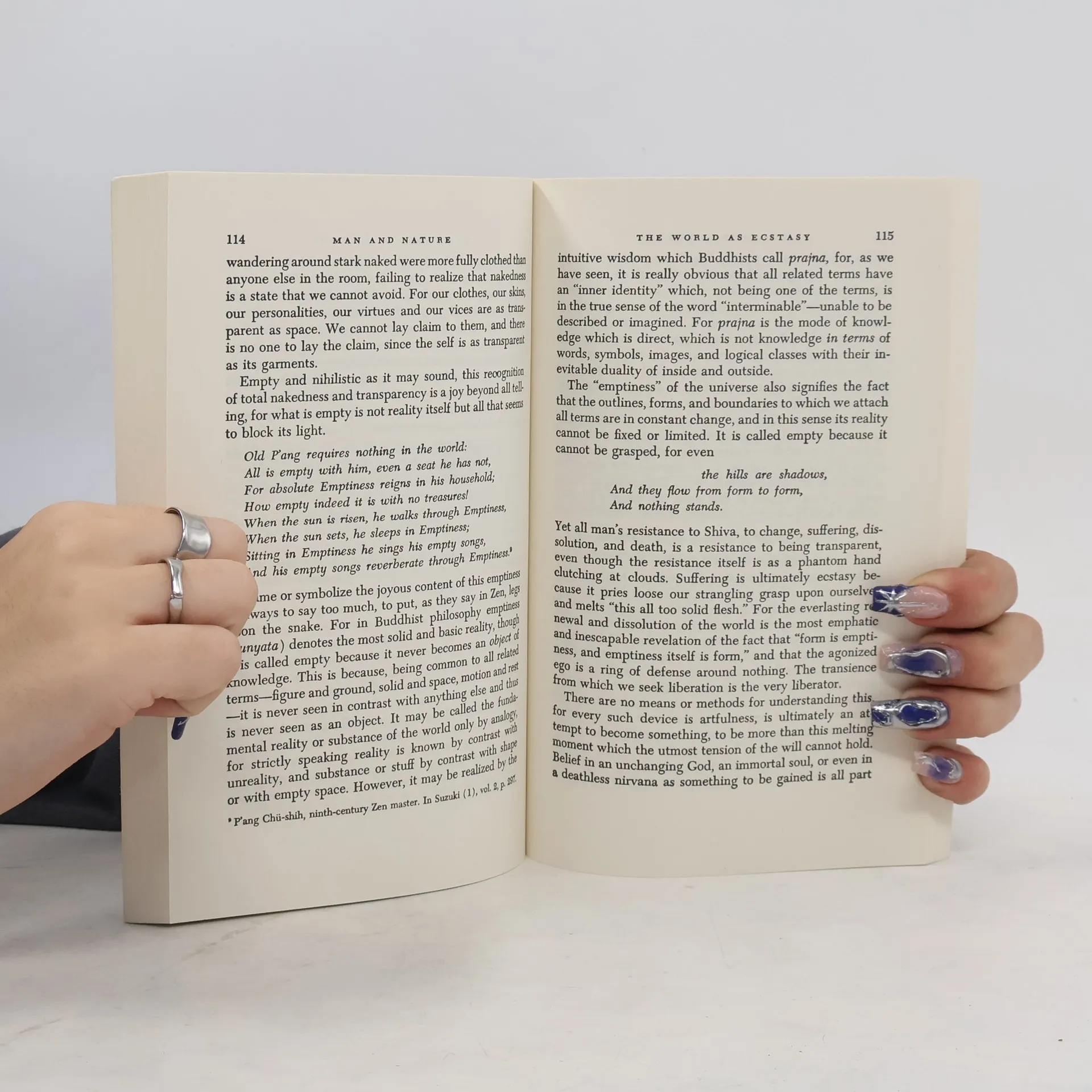
From “perhaps the foremost interpreter of Eastern disciplines for the contemporary West—and an author who ‘had the rare gift of ‘writing beautifully the unwritable’” (Los Angeles Times)—a guide that draws on Chinese Taoism to reexamine humanity’s place in the natural world and the relation between body and spirit. Western thought and culture have coalesced around a series of constructed ideas—that human beings stand separate from a nature that must be controlled; that the mind is somehow superior to the body; that all sexuality entails a seduction—that in some way underlie our exploitation of the earth, our distrust of emotion, and our loneliness and reluctance to love. Here, Watts fundamentally challenges these assumptions, drawing on the precepts of Taoism to present an alternative vision of man and the universe—one in which the distinctions between self and other, spirit and matter give way to a more holistic way of seeing.





Buchkauf
Nature, Man and Woman, Alan Watts
- Sprache

- Erscheinungsdatum
- 1991
- product-detail.submit-box.info.binding
- (Paperback)
Hier könnte deine Bewertung stehen.
- Sprache
- Englisch
- Autor*innen
- Alan Watts
- Verlag
- Vintage Books
- Erscheinungsdatum
- 1991
- Einband
- Paperback
- Seitenzahl
- 115
- ISBN10
- 0679732330
- ISBN13
- 9780679732334
- Reihe
- Schlagwörter
- Sachbücher, Sozialwissenschaften, Esoterik & Religion, Lebenshilfe, Psychologische Thematik, Religiöse Themen, Philosophisches Thema, Religion, Philosophie, Frauen, Spiritualität, Buddhismus, Spirituelle Entwicklung, Mystik, Männer, Zen, Taoismus
- Erstveröffentlichung
- 1958
- Originaltitel
- Nature, Man and Woman
- Bewertung
- 4,15 von 5 Sternen
- Beschreibung
- From “perhaps the foremost interpreter of Eastern disciplines for the contemporary West—and an author who ‘had the rare gift of ‘writing beautifully the unwritable’” (Los Angeles Times)—a guide that draws on Chinese Taoism to reexamine humanity’s place in the natural world and the relation between body and spirit. Western thought and culture have coalesced around a series of constructed ideas—that human beings stand separate from a nature that must be controlled; that the mind is somehow superior to the body; that all sexuality entails a seduction—that in some way underlie our exploitation of the earth, our distrust of emotion, and our loneliness and reluctance to love. Here, Watts fundamentally challenges these assumptions, drawing on the precepts of Taoism to present an alternative vision of man and the universe—one in which the distinctions between self and other, spirit and matter give way to a more holistic way of seeing.